11 January 2006

Macworld 06

The true Mac fanatics were a bit disappointed that their fearless leader, Steve Jobs, didn't announce a completely unexpected and never-before-imaginable new product when he gave his keynote yesterday at the Macworld Expo yesterday morning. I, too, would have liked to have seen the rumored updated Mac Mini with an Intel chip in it (the Viiv chip, if you care), that will also serve as a DVR. But no worries: Steve is going to revolutionise your living room, it will just take a bit longer, and I think he wants to have the stage again for a separate event that shows how (and a new media cycle to cover this event). Plus, I think the 13.3 inch widescreen Intel iBook (MacBook?) is also on its way in a bit.

Unrealised rumors aside, there is much good news coming from San Francisco:
  1. Apple is making so much money on iPods - they sold 14 million over the holidays - that they'll have the time do their Tivo-killing App the right way.
  2. They are making the transition to Intel seamless, and the press has already changed their tune on this – from thinking it might derail Apple's success to seeing it as part of that successs. The new Intel iMac is already shipping, and the Intel MacBook Pro (note the new name) is just about ready to go. This is impressive when you consider the engineering required to switch the entire platform from one processor architecture to another. And one will never again have to hear Macs are slower than PCs'. Ever.
  3. Apple software keeps getting better, giving folks more reasons to run OS X over Windows. iLife 06 with iWeb is very cool indeed, and iWeb may lead this blogger to abandon blogger. While word is that iWork 06 gives us a version of Pages that will make it even easier to stop using MS Word. The new Pages is said to have endnote capability and track changes, the two showstoppers for academics like me. I've been using Pages as my main Word Processor since the autumn, and it's a nice App.
  4. With hardware based on Intel chipsets (and motherboards), it will be only a short period of time before you can run Windows XP and XP programs on your mac. Toss in the glory and goodness of Tiger and iLife and iWork, and it might actually be possible for Apple to increase market share just a bit and solidify their position in said market.
In other words, by the end of 2006 there will be no reason not to buy a Mac.

10 January 2006

A CNN/USA Today/Gallup poll of 1,003 adults found that 50 percent of those polled believe it's OK to forego warrants when ordering electronic surveillance of people suspected of having ties to terrorists abroad.
This poll tells us almost nothing meaningful at all. The fact that some folks think it's OK to spy on people when condition X applies is just fine and dandy. But how do we know if condition X applies? The reason it was clearly wrong and clealy illegal for Bush to circumvent FISA, is that the whole point of issuing a warrant is to give a disinterested body the power to decide if condition X applies. The demos as a whole may, with this system in place, also make decisions as to how to direct that given body as to when and if, certain conditions having been met, specific actions can be taken. My understanding of FISA, limited as it is, was that Congress was saying that the conditions to be met were somewhat minimal (almost all FISA requests have been granted) and the actions to be taken somewhat broad. For god's sake, it's a secret court that issues the warrants.

Thus, to ask individuals whether it's OK to spy on citizens who 'have suspected ties to terrorists' is merely to beg the question of how we know they have such ties. If a court looks at some evidence – even minimal evidence – and says, 'yep, there are terrorist links here, spy all you want', then I say fantastic. But this poll question is asking: 'is it OK to spy on citizens without court approval (even secret court approval), so long as X' under conditions in which X is unkown.

Even worse, the presentation of the poll 'results' is used to suggest that 50% of Americans think it's OK to have no court check on executive surveillance of American citizens, but I don't think that's what people thought they were answering. Because there are two different questions that the Bush administration is successfully smushing together in their moves in the political game. The questions are:

1. Is it OK to spy on US citizens without a warrant?
2. Is it OK to spy on US citizens who have ties to suspected terrorists?

The answer to #2 is almost certainly yes. The answer to #1 should be an unequivocal no. But the media is cooperating with Bush et al when they pose a poll question to Americans that collapses the two questions together.

All of this, by the way, has a lot to do with the conversation at Emery's over rule of law. Sorry I'm not coherent enough to make enough of the links there, but I will say this: I mostly side with Frances on this one. While I'm a big fan of MLK, I think he means something different by 'law' than we do when we refer more narrowly to 'rule of law'. In terms of rule of law, a law can be unjust. It's an external (though very powerful) argument that says an unjust law is no law at all, that 'injustice anywhere is a threat to justice everywhere'; it's an argument that shows us, rightly, in my opinion, that rule of law is not nearly enough. Right now, however, it seems to be more than we've got.

07 January 2006

elephant = hathi

Different people experience India differently, and it's one of the more interesting things to vicariously experience it for the first time again through this great group of tourists I'm leading around. the touts that haunt every major tourist site are always a problem for people, as they are aggressive (in northern India primarily) and the more popular the spot, the more aggressive and numerous the touts. this group has taken to calling them the "hello people" because they say hello! hello! to get your attention. some have decided ignoring them entirely is the way to go, others have gone with firm "no"s and others have engaged with them, sometimes buying things, sometimes just trying to make the experience a bit more palatable. This of course backfires because the touts see a softy and go for that person, so you get more touts, but you do in the end get to converse with people who, yes, want to sell you something, but also have families and will chat about pretty much anything.

I've decided after years of following the first two options that the third option is my preferred route. yesterday I practiced a little Hindi with a small girl selling "hathi patas" or elephant images (one of which, yes, I bought). Her name was Usha and she lied and said her didi (sister) made the item, when in fact they are mass produced in Rajasthan by workers there, I'm sure. But she was sweet and was suitably fascinated by my Hindi, all of which worked to give her the sale.

as I've blogged before--negative energy just puts more negative energy back in the world, and it reinforces and heightens whatever negative things you've got going on in your life aside from annoying touts. it's made me more of a target, perhaps, but it's also made my time in India a casual, comfortable one instead of one where I'm constantly fighting for my space and my right to be "unbothered" by touts.

one of the travelers with us, who unfortunately had to leave today because of a death in her family, was saying that she felt especially bad ignoring and brushing aside the touts outside of Ajanta--after seeing these amazing Buddhist excavated spaces with paintings all over them depicting narratives of meritorious and righteous actions, she just couldn't reconcile that with the actions she herself (and all of us) were participating in outside of the ancient realm. I think it's important to make that connection, one which I almost never do, but when you're in the site itself and surrounded by these wonders, it's hard not to be affected by the messages the images are teaching.

It's great to be with such empathetic and inquisitive people, interested in what I'm interested in, and fascinated by the things I know (and the things I don't know...)

06 January 2006

India: highs and lows, very lows.

our Aurangabad-Mumbai flight was unbearably delayd (5 hours) which meant sitting in what barely deserves the name of "bus terminal" airport in Aurangabad. But spirits were high, so we were fine, got into the hotel at midnight, had a quick snack and were in bed by 1:30--no worries. And up at dawn to catch the ferry out to Elephanta. Elephanta was amazing--wonderful sculptures, just a great excavated temple on an island in the middle of Bombay harbor. it's one of those works of art that works primarily because it simultaneously holds together so well and leaves the door open for interpretation. it's not closed off--it begs questions.

and then there's the lows. like literally flushing your brand new cell phone down the toilet lows. Now to be fair, there was no flushing involved on this toilet, so the literal aspect isn't quite right. but yes, I seem to be just that klutzy, stupid, and jetlagged. many expletives were yelled, but luckily (as we were on the boat) there was no hope of retrieval--or else other decisions would have been in my hands (literally, again) that I would not have enjoyed. and eventually, perhaps in about 10 years, I will be able to truly laugh about this. right now it kind of sucks. But trying to move on, and enjoying the wireless internet in the hotels. ichat anyone? it's 4 am there....

03 January 2006

Humor: for those who think marriage has nothing to do with the state

Here's a nice image, captured by a friend of a friend at an Atlanta courthouse:
marriage

BOM-IXU

Ah the joys of the domestic terminal at Bombay. I'm here, in one piece, I still can't hear anything, but the flights were fine--great even, given that they were two long flights with 8 hours in London in-between. I can highly recommend the quiet waiting area at Heathrow Terminal 4, where you can sleep almost horizontally in quiet and low light--I got a good three hours of sleep there before getting on the flight to Bombay. I am now in the "iway broadband internet cafe" inside the domestic terminal, where there isn't really a cafe at all, just some computers, but I will say that the broadband is definitely in evidence and a huge improvement over earlier internet kiosk experiences I've had in India. It is Bombay, after all.

The Aurangabad flight is (natch) delayed, but there is (natch) a fabulous bookstore (in a space smaller than most bathrooms) which has every postcolonial/contemporary INdian novel you've ever seen, including the new Rushdie which may have to be one of the things I lug around this trip.

Tomorrow is the 5th century excavated Buddhist and Jain caves at Ajanta all day, so wish me luck!

01 January 2006

SFO-LHR-BOM-IXU

weather and british airways willing, I'll be off on the travel extravaganza of early 2006, and if you already knew what airport IXU is, props to you. I do have to take the free bus to travel the 4 km between international and domestic terminals in Bombay, and if you think that's third world, you haven't traveled through Sydney.

I will say that our arrival in San Jose international (SJC) was a bit of an introduction to the third world. After walking down off of the airplane old-school, we wandered through a makeshift canvas tunnel for at least 100 yards before reaching the far end of the terminal building, which we had to traverse entirely (passing both ticketing and bag claim) before getting to the bus to the rental cars. and the place was packed with people, all grumpy and toting hordes of boxes, bags, and other loot from the recent holidays. most with children in tow. not a good scene. it is just another example of how physical space shifts the way people behave. if you feel like you're in a gritty, disgusting bus terminal, you tend not to be happy. if you're in a high-ceilinged, clean, spacious terminal (new buildings at Detroit, the Chicago terminals, the main hall at Denver, terminal C at Newark, the Bristol airport we have recently become very familiar with), you end up acting differently, carrying yourself differently.

A friend of mine was conveying the difficulty of finding a high school for their child, the struggle of public v. private school and the normal worries about both. But what concerned her most about the public school she visited (which had a decent reputation) was the space: you treat kids like criminals and place them in a space that seems like a poorly-run prison, with flaking grey paint, metal detectors at the door, and nary a color in sight, of course they don't want to learn. Perhaps they learn to live in this world, which I suppose is valuable. But again perhaps the world should change??

So I'm off to India for a month, and will try to post from there when possible (read: facilitated by the 5-star hotels we'll be staying in). I'm looking forward to yummy food, seeing pretty things, and hanging out with Ruth in Delhi. many happy returns for a wonderful new year to all y'all.

31 December 2005

Veronica Mars

Truly: 'Best. Show. Ever.'

We just completed an intensive two week viewing of the first season of Veronica Mars. When the show originally aired in Fall of 2004, it was the only show of the season that we were honestly excited about watching. Unfortunately, State College, PA simply does not carry a UPN station. We had the everything digital cable package, but it did not include UPN. Thus, we spent the past 18 months hearing echoes from both critics and friends about how brilliant the show is, including the Joss Whedon quote above (and previously referenced here, though I'm too lazy to post the link).

All I can say now is that the show is brilliant. It's written so taughtly, the characters have such depth, and the season's story arc is astonishing. If that weren't enough, the character of Veronica rivals Buffy in terms of high school girl heroine.

I can't wait to watch the first season through again, and I'm crossing my fingers that Steve Jobs will announce UPN shows availability on the iTunes Store at next week's MacWorld.

30 December 2005

Snow by Orhan Pamuk

I mentioned to L when we were in Seattle the other week that Snow is either very bad or high literature. It walks that line, and I think most of the time it leans toward the latter. It's a story set in a snowed-in town called Kars, in eastern Turkey, and focuses on the main character, Ka, a poet, who has come to town ostensibly to write a story on a rash of suicides by local girls but in fact has come because he is in love with a local beauty. The novel is fairly masculine, which in itself isn't usually a problem for me (exception: Catcher in the Rye) but here just becomes kind of stifling after awhile.

The prose is solid, and very occasionally even brilliant, and the depiction of the characters, from Ka himself to the first-person narrator that inserts himself in odd places throughout, to Ipek, the focus of Ka's love, or even Blue, the rebel Islamist, is very well done, particularly as you simultaneously find yourself not really knowing the characters and knowing them quite well. The novel has a very Eastern European/Russian feel to it as a result: it reminded me of Gogol, with the main character going to visit all of these other characters and asking them things, describing them, but always from the narrator's fairly narrow perspective, so we end up chuckling sometimes at the descriptions but never quite fully trusting anyone in the book, from Ka on down.

the political backdrop for the novel involves an anti-secularist movement within Turkey, with overtones of Kurdish separatism/nationalism and a range of different Islamist groups. Theater also figures prominently, which has an interesting layering effect for the book: it is a novel about a poet who often watches TV broadcasts of plays which sometimes bleed into way-too-realistic "performances."

So if you like Russian novels, and can embrace the masculinity, I think this could be a good read. Or, if you're up for a bit of a hard slog to expand your reading horizons a bit, but not necessarily with a huge payoff, then I'd go for it. Others really liked the book—Salon put it on their best books of 2004. I'm not so sure.

29 December 2005

King Kong: worst movie of the year

okay, maybe not worst. But definitely worst out of the films I've seen this year, and I saw War of the Worlds. Which was bad. so in my first post back in a while, I just need to vent and rail against this unrepentantly primitivist—strike that, it's plain racist—boring, waaay too long (sageblue suggests half an hour, I suggest at least an hour and a half), and way too proud of itself. Yes, it's beautiful (to steal the only line of the film), and it shows that the director, cinematographer, and editor love the widescreen shape and composing things within it. so we get to pause on the ape's face for about 15 minutes of the total, and poor Naomi Watts gets to scream, cry, moon at the camera for another 20 or so, giving them some time to cut right there! see, it's not hard!

And yes, it's a remake, so we can forgive some of the Orientalizing/Primitivism/racism, but could he have played it a bit differently for the 2005 context? Oh, no, instead let's play it up, making the "natives" a cross between the infected people in 28 Days Later, images from 19th century freak shows, and Linda Blair in the excorcist, only very very black? I know Orientalism is cool these days, what with Peter's earlier use of the turban-wearer-riding-large-elephant-as-evildoer motif in the Rings trilogy, but this is way way over the top. And where do these folks go after the initial hour? a bit of a narrative hole there, no?

the writing could not have been worse, wasting the excellent acting ability of Naomi Watts (yes! beauty! beauty!), Adrian Brody, and even Jack Black, whom I enjoy and respect—comedy is hard, and he's good at it.

Sure, special effects, blah blah blah. really? do we have to be impressed by this anymore? didn't Lucas prove that special effects do not a decent movie make? or a bad movie save? the dinasour chase through the canyon was fun, for the first age and a half, until it turned into the endless Agent Smith fight from Matrix 2 and became utterly ludicrous. the bug/snake/centipede etc. thing was way way better in the Indiana Jones series, and they could write back then (snakes, why does it always have to be snakes?)

I'll close with this: the moral of the movie is that if you are a manly man you protect your womanly woman by fighting other manly men for her. So if anything redeems the film it's its support of patriarchy, which as my readers know, I'm so completely behind.

27 December 2005

History?

When it comes to knowledge of history, I usually feel confident laying bold claim to being one of the more ignorant folks you will encounter, especially for someone with a bunch of worthless degrees. I never studied European or World History of any sort in high school (it just wasn't in the curriculum) and I never took a single History class in College. Simply put, I know very little history.

This was made quite clear to me in a lengthy discussion a few weeks back with the son of one of my colleagues, called Luke. Luke was discussing British history in depth, making arguments about English nationalism, colonialism, and monarchical rule. I couldn't challenge any of his arguments, because I hardly knew any of the history he was covering. Luke is 10 years old.

Thus, it frustrates me even more – and would lead me to rant in detail if I knew any details too rant about – that there seems to be such shockingly little regard for history in the world around me of late. Two banal cases should suffice to capture my rather vexed state:

  • The AP article from this morning's 'newspaper' (local Vancouver press), describing the proposal in Congress to do away with 'Birth Citizenship' for illegal immigrants. In true 'objective' fasion, the article tried to present 'both sides' to this issue, but failed to mention in any place that coming to America so that your kids will be American is nothing new but rather has a long and interesting history. Some might even argue that knowledge of that history shows us that this practice is quintessentially American - part of the very fibre and fabric of the country.

  • The vast commentary on Brokeback Mountain. Almost no one among the cacophony of voices seems to understand that the movie is set in the early 1960s, in Wyoming. Stonewall is 1969 folks! These guys aren't gay, because 'gay identity' does not yet exist in the world. They cannot act and talk and think and make choices the way we might wish them to in 2005 (that is, if 'we' live in so-called blue states), because there simply is no subject position available to them in which they might express a so-called gay identity. And that's not the same as saying their 'true nature' is closeted, repressed, or whatever else, because in the time and place and context that these two grew up, they had no gay identity to express. This isn't medieval European history, it's just a few decades ago, but it's history nonetheless.

holiday cheer

I wish I could report that I have been lolling around in my pajamas, eating copious amounts of carb-filled dressing and generally wallowing in loot, but while that has taken up part of my last few days, I have in fact been working to finish the unending index and copyediting for the Asian Art anthology. Two words: not fun. So apologies for the unexpected hiatus. I will provide review of King Kong (D-), recommendations on who should read Pamuk's Snow, and other enlightening tidbits once I surface.

21 December 2005

bullet point life


  • U2 is the best live band ever and we lurv them. Bono is on both of our "lists" for those whom the other is allowed to sleep with if given the opportunity. I believe The Edge is also on that list for both. Sadly both of them are married, which is of course the primary barrier for this to happen...

  • I second Sam's assessment of Brokeback, and am frustrated that the critics seem not to be able to employ the word "queer" in an intelligent way, insisting on reading the film as one about "gay identity" when in fact it is utterly not gay and completely and utterly queer. I imagine there will be more on this as we will see the film again very soon.

  • a Washington Post article printed in the local Vancouver paper in the back of the Life section (don't ask. of course one shouldn't read these things) on the important seasonal toy safety warnings mentioned that some of these toys that have been recalled are "made-in-China cheap." really? the Post can get away with this kind of racist language? I suppose so. sad and horrifying.

  • we're in Seattle. good coffee, and they have half-and-half in this country, which is a Good Thing. Mmmm Milky goodness.

  • the home of OaO (physical, literal home) is fabulous and thus we hate them and surge with jealousy.

Brokeback Mountain

Dan was insistent we see this movie asap, and since we owed him for his devotion to Serenity (and Joss), we have complied. Thus, both secondamericano and Odds Are One have now viewed the movie.

My initial opinion? Movie of the year. Hands down. Seriously.

19 December 2005

stateside

So we are now in the (good ol') US of A, well, at least in the northwesterly portion thereof. Still about 2 inches to the left due to soul lag (see earlier post on this). we are prepping for the U2 concert by listening to nothing but U2 all day, thereby taking the gluttonous route to enlightenment rather than the ascetic, of which I heartily approve. We have been reunited with the doggy, which is a good thing, and other than that we are lying low, recovering and prepping for U2. Oh, and there seems to be some sort of "holiday" thing. In the UK we call it "Christmas" but here there seems to be some sort of "war" on this. The etymologist in me wishes to remind the American public of the root of the word "holiday" but that would be too erudite, wouldn't it? Ah well. More reports from the front over the couple of days...

16 December 2005

'Sorry, mate. The house is full'.

That was the Inn Keeper's response when Mary and Joseph came calling for a room in the story of Christmas, as told by the play put on by the local school last night. We went to watch our friends' kids perform, and it was quite a sight. Afterwards, we went back to theirs for mulled wine and mince pies.

As you can see, we're on the precipice of going native. But in a few hours we return to the land of the 'free'. Should be quite an experience.

15 December 2005

Joining in at Emery's place, again

I was going to comment on Emery's post, but I was afraid I'd carry on too long. And besides, I think the discussion over there bleeds into discussions at Paul's place. So perhaps I can serve as a bridge. Here's the bit from Emery that interests me:
is it true that it's impossible to cognize (not sure what work "cogniz[e]" is doing) the experience of (again, not sure what work "experience of" is doing here) death rationally? Or is it just the case that the thought of our personal extinction is, well, unpleasant? It seems to me that it's easy to conceptualize death. Go to the wall and flick the light switch. One second the light is on, the next, it's off. The off position is death.

First off, as a heathen myself, I find the matter-of-fact nature of Emery's metaphor quite appealing; I'm somewhat drawn to the idea that death is fairly simply. However, I think Emery is cheating here. He dismisses the work done by 'cognize' and 'experience' so that he can then go on to 'conceptualize' death by offering us this very nice metaphor. But conceptualizing death is not cognizing its experience. The work cognize is doing is to make the link to epistemology. This means we're not just saying what death is like (as Emery's quote does), but saying something about knowing death.

How can we know our own death, or know an experience of it? This is the question that TMcD says leads us to religion. I see how the question drives us to religion, but I don't see how it really answers the question. That is, here I side with Emery, because I think religion is more like a metaphor or a conceptualization; it tells us what death is like, or how it's going to be, but it doesn't allow us to cognize it. And, in that sense, Emery's light switch response is spot-on.

On the other hand, I'm probably missing something about the religious experience; of course I am, since I don't have the religious experience. But the question about cognizing death doesn't have to lead to religion. It could lead to Heidegger. It could lead to an awareness of our own finitude in the world. It could lead to a realization of the limits if epistemology, which means that in asking about 'cognizing death' we're asking the wrong question.

14 December 2005

Unsettled

I'm not feeling very settled ontologically right now, and perhaps that explains the dearth of recent posts from me. The term ends in less than 48 hours, and the marking for December will be wrapped up tomorrow. Thus, there are no major, impending deadlines, but there are a huge number of projects waiting in the queue. None of which I feel I can start, as first we must fly for just shy of 24 hours to get back to my parents for Christmas (sorry, over here everyone says xmas instead of happy holidays, and I'm starting to get used to it).

But really, the work to get done, or waiting to be done, is just a (lame) metaphor for life, as we're sort of waiting for that to start as well. Thus, we've been internet home shopping (and I've been planning the next hot tub installation - there are exciting new developments on this front, let me tell you), but none of these projects are ready to take off either - that is, until we are more settled.

And there's the paradox: to 'get settled' we really need to do some settling (e.g. bring our dog over, our books, our belongings, etc.), but we have to hold off on doing the settling until we're more settled. And I think that this likely points up a general condition of life: we wait around for it to get started, and thereby don't do much living of it. Sometimes.

In the meantime, work will serve as a proxy, as I already have 3 books to complete and yet I somehow find myself in dicussions with a publisher about writing am intro textbooky type thing on 'gender'.

12 December 2005

academic generosity

so not such a hot morning, as the Oxford Art Journal sent me a rather terse e-mail rejecting my submission (of July 2005) without any comments, feedback, or readers' reports. for those outside of academia, this is fairly normal, although I find it ethically reprehensible, and thus my post.

I imagine that few people end up kvetching about this sort of thing because, well, you have to admit that you have been rejected, which as is now clear, I have no problem with. It sucks, but at least I sent something out, right? what angers me is the lack of care amongst the academic community for the "greater good." Perhaps it's a side effect of living in this slightly more generous culture over here, and perhaps it's a side effect of not having a job and having more time to give to colleagues, more space in my heart/brain to be generous and help others get better, succeed, do well rather than resenting others for doing those things. over the last three years since I left St. Mary's, I have decided that both positive and negative energy come back to you; it merely depends on what you put out there. Not to say I'm some saint now and exude the glow of Enlightenment (in the under-the-Bodhi-tree sense, not the Cartesian one), but I just like helping other people do well in their chosen path, and I find that when I do that, my chosen path becomes easier. I am helped by helping and by those whom I help.

So, when I had to write rejection letters to hopefuls for the panel I co-organized for CAA (art history's MLA, for those lit folks following), I made a point of writing individual letters and offering substantive feedback on their proposals, taking their intellectual projects seriously and trying to help them succeed in their next proposal. I invited them all to come to the panel and participate, and several e-mailed back indicating that they would and that they appreciated my comments, which was gratifying, but also the first step to building a real community with these other scholars, who clearly do something interesting to me (or else they wouldn't have been interested in my panel).

Yes, this process took some time. A bit more time than generating a single stock letter and e-mailing it, or a lot more time than generating a one-line e-mail (yes, we've gotten those too). But the investment there will come back to me somehow. And I'd rather invest there than in an endless meeting divvying up $10K for technology spending across a campus of 250 faculty (shout out to Ruth and Sam there). It seems, now that I'm on the outside and sometimes looking in, that academics should be smarter about this. They should come together in support of one another and the sometimes isolating project of intellectual writing and thinking, helping to hone that process, valuing it rather than dismissing it or tearing it down.

to put it another way (quoting my Mom here): how hard is it to be nice? so I will stubbornly continue to be academically generous (and I hope in other ways as well) and see what happens. Fie on one-line e-mails and blanket rejections! May the work of the editors of Oxford Art Journal receive greater care and generosity than they have given mine.

11 December 2005

Woog's Hockey Wisdom

of course, most readers of this blog will be familiar with the top two Minnesota pearls of wisdom, handed down over the broadcasts by the former coach of the Golden Gophers' men's hockey team. For review, they are:
  • always hold hands when crossing the street
  • a shot on goal is never a bad play

of course. this much is obvious. today, we are honored to announce rule number three:

skate first, play later.

amazing. it seems like my earlier post encapsulated in one bumper-sticker-/t-shirt- worthy pithy phrase. we love woog.

10 December 2005

procrastination tools

it seems that everyone in the blog-o-sphere is posting "light posting warnings" (perhaps that's why I'm posting a bit more, just to make up for it, be a bit different. oh, and I'm unemployed...) so I thought I'd post a few links for those working too hard to make up for the imminent "vacation" which will be less so because one is working too hard now and will then again do so afterwards...

Ruth has alerted me to this awesome site, which one must check out to experience its coolness. why is it mesmerizing? I don't know. just go there.


and as I have a new phone now (see pic) of course (it's been almost three months! of course I have a new phone! plus look how thin and small!) I was looking for ringtones (the phone's stock ones ranged from obnoxious "classical" music takeoffs to backbeat nightmares) I found this site, which is, like the one above, fascinating.

Have fun!

09 December 2005

Mangal Pandey 2005

I'm sure those of you reading this were waiting on tenterhooks for the review of Mangal Pandey: The Rising, the Hindi film starring the hunky Aamir Khan as the purported hero of the 1857 Uprising (that's the Sepoy Mutiny for those hard-core Brit-o-philes keeping track; for those Indian nationalists in the audience, it's the First War of Indian Independence; for those educated in the US secondary school system don't worry, you won't have had to know this for the exam). Aamir was the hero in Bollywood's hit film Lagaan and he was the anti-hero in Deepa Mehta's brilliant and extremely harrowing Earth, about the bloody Partition of British India into India and Pakistan.

Khan's performance as Mangal Pandey, an historical figure whose role in the events of 1857 is, well, exaggerated, as any search for a singular hero of an event as complex as a fight against colonial rule would be. (For those thinking: where have I heard this name before? If you've read Zadie Smith's White Teeth he figures as the esteemed ancestor of one of the characters.) The film comes out at a time in India's history at the tail end of over a decade of Hindu nationalist/fundamentalist politics, marked by a rise of the VHP and BJP in the late 80s and their rule in the 90s until the re-taking of India's government by the Congress party in 2004. At least we hope it's the tail end. Perhaps the doomsday argument might also fail to say anything about this problem. So it's an interesting time to focus a film on a Hindu hero whose religion dictates that he may not consume beef, and when the bite-off ammunition cartridges the British demand that their Indian soldiers use are found to be coated with beef fat, this becomes the catalyst for the revolution. It seems they are also coated with pig fat, thus including the Muslims in the army in the offended group, something that seems a bit far fetched, but this is how myths work. (not that the Brits didn't coat the cartridges with animal fat, I imagine they did. it's just doesn't it seem odd they'd use both animals? isn't that less cost-efficient?) The politics of the timing of this film are underlined by its release date: August 15, the date of India's independence from the British.

Others I'm sure will and have discussed the historical accuracy of Pandey's role, the over-glorification of his figure, the actuality of the Brits killing peasants for growing opium illegally (ie not for the British East India Company, who had a monopoly on opium, oh, and on everything else pretty much), the plausibility of the women in the "harem" going out and doing some dirty dancing in the village with the locals, and on and on and on. So, it's a Bollywood film. accuracy not quite its strong suit and the disclaimer at the beginning hedges its bets. The disclaimer says something like: well, some of the characters are real, others are amalgams, others are made up and the events are, well, what we decided likely must have happened, based on a general idea of the history, with some liberties taken. Okay, so that's not a direct quote. But it's the gist.

The film tries to fit in every aspect of colonial rule in India. So we have:
  • white woman inadvertently touched by innocent Indian servant, who is then beaten in reprisal by ogre British officer in defense of her womanhood (see: Jenny Sharpe, Allegories of Empire)
  • selling of women in the market, witnessed by said white woman who is suitably horrified and runs away
  • "nautch" girls (nautch refers to a courtly practice of maintaining a group of dancers for the entertainment of the court, so hence the quotes) who are prostitutes for the use of the white officers, supported by the East India Company. The last part is accurate, by the way: in early Company rule the rate of death from VD was so high that they started a program of keeping their own prostitutes so that they could keep them "healthy." See Veena Oldenburg's fabulous book on Lucknow for this.
  • representation of untouchability as bad, a lesson our hero learns the hard way (also a theme in Lagaan)
  • Hindu-Muslim amity (this is a must for contemporary bollywood film, they tend to include this somewhat too obviously)
  • slimy Parsi businessman, repeating at least one ethnic stereotype that is unbelievably insulting (the Parsis figure in Mehta's film Earth as the central family, in a balanced portrayal)
  • the friendly Company officer painting along the banks of the river, in an approximation of actual amateur painting from the period, nice little nod to art historians in the house
  • said friendly Company officer is, of course, Scottish, as many in the officer corps were.
  • and, finally, we not only have a sati (widow immolation on the pyre of her dead husband) but the subsequent saving of the woman by the heroic Brit and our hero Pandey. no, that's not enough, as then, having nowhere to go, she becomes the lover of the heroic white officer....

In addition to the traditional Hindu-Muslim amity moments, several stock-standard elements for Bollywood:
  • they manage to fit in a courtroom scene, a must-have for any self-respecting Bollywood film
  • they fit in a scene of Holi, the spring celebration of the upturning of societal norms, which I suppose is a nice metaphor, but it appears with no narrative couching whatsoever
  • the whiteys speak easy-to-understand Hindi, which is nice for me and likely hilarious for native Hindi speakers; I will say it's better white-Hindi than in Lagaan, which was clearly painful for all involved.

The film's strengths are that it does not try to make things easy for its heroes or the audience. The tension of cultures and power between the white officer and Pandey is much like that depicted in A Passage to India [book | film], where the two protagonists realize they can never truly be friends because of their relative positions in this colonial drama. Points for the film. But the need to fit everything possible into the movie that took place during colonial rule is a bit much and distracts from the central narrative. Generally Hindi films tend to ramble a bit, but the better ones link everything together, giving you reasons for the asides, making the songs a driving part of the narrative (rather than interruptions from the chorus, as they seem to be here), and weaving complexities together so that they become one tapestry. What ties this film together is the character of Pandey, and indeed, Khan's performance is wonderful and he does anchor the film. As does the acting of Toby Stephens, who plays the Scottish officer William Gordon, with a rock solid performance. I came out of the movie thinking it would be an interesting end-of-term film after teaching a course on Indian colonial history, as it touches on everything at once and would spur good discussions. But as a film it's not the best example of the genre. Go with Lagaan or my fave, 1965's Waqt.

08 December 2005

"Religion" vs. Religion

Over at Emery's place, they're having a comment war worthy of a high-profile blog; it's mainly here but perhaps also here.

I think some of the invective develops out of a confusion over the difference between religion and "religion." Emery is concerned to talk about the former, in the terms of how we might define it, by just looking at the content of various religions and trying to come up with its minimal content. TenaciousMcD, in the comments, offers a political response, that I think is focused on the latter: the discursive and therefore political use of the term, what it means in context. The evidence for my hypothesis can be found within the flame war between TMcD and CuratLex, where the latter does in fact assume that the former is not religious precisely because TMcD supports the democrats.

I'm thereby reframing TMcD's original argument, but basically I buy what he says:
what exactly are the minimal requirements to qualify as "religious" in today's non-creedal America? I think there are really two: 1)you profess to believe in God; and 2)you at least lean Republican on cultural issues (abortion, gay rights, etc.). The sign of being VERY religious is that you strongly support the GOP on BOTH cultural and economic issues.

Now this may not make much logical sense since the major criterion (the second) is not religious at all. But what I would suggest is that, precisely due to the lack of natural common ground among believers of disparate faiths, politics has filled the gap, and the GOP has rushed to offer a unifying political content to vouch for "religious" credibility.


My sense of things after a few months in the UK, is that this political construction of "religion" ("filling the gap") has not occurred here, and for that reason religion doesn't matter much at all (which is not to say there are no believers here). This creates a context in which it would be easier to have the discussion that Emery initially aimed to have. I think that in the US it's almost impossible to talk about religion without invoking the politics that TMcD describes, and that's because of the success of the radical right's effort to tie religious symbols to political affiliation, and vice versa.

I wonder if it doesn't also have something to do with faith. I don't know many folks who have genuine faith, but the one's that do (one sometimes reads this blog, and one is TMcD himself) don't seem to have any interest whatsoever in politicizing that faith. When those on the right in US politics politicize theirs, I tend to assume, then, that they don't really have much faith at all.

07 December 2005

Who Would you Vote for?

Here's The Guardian's Description of the new leader of the Tory party, David Cameron.
This afternoon he will visit east London to talk about social justice; a speech on the environment will follow within days. The coming weeks will bring an announcement on measures to increase the number of women MPs, a theme he stressed in his victory speech yesterday. ...he intends to abandon such things as education vouchers and support for private healthcare. As a leader who describes himself as a small-l liberal he will calm the party's obsession with issues such as asylum and immigration, and not just for symbolic reasons.


Yes, folks, the Tories are the party on the right in this country. So if you thought of yourself as being somewhere on the left of the so-called political spectrum, and you had to choose, hypothetically, between...oh, I don't know, say, John Kerry, and this guy, who would you pick?

06 December 2005

Giant 1956

I recorded Giant, that mid-50s sublime, sweeping, elegant, and I would even say expressionist film starring Rock, Liz, and James. What a trio. I had seen it years ago in my teenage James Dean phase, which only later I realized very few girls in the 1980s went through. I blame/thank Mom for this one. Giant is an amazing film, and only in seeing it again this past week (and yes, it was seen over the course of a week in small chunks. the thing is hours long!) did I recognize its brilliance. It has everything: class warfare (nouveaux riche meets rancher/Texan rich meets Maryland aristocracy), gender (boy howdy Liz's character is a firecracker, and Luz? one of the most poignant portrayals of queerness from the 50s, if I may be so bold), race (the fight in the diner is still one of the most horrifying scenes on film), nationalism/Texas separatism/patriotism (eg said fight with the Yellow Rose of Texas blaring from the jukebox), and modernity in all its glory (the rise of the oil rich and the entry of technology, from phones to planes, alongside the o-so-fabulous interior design choices at the mansion. sigh.)

Can James Dean act? I don't know. It seemed as though the director was more interested in fun noir lighting whenever we had a closeup of him, and thus it's unclear. But the range of emotion/age he is asked to portray, and the line he walks between sweet and lecherous is just too precise to really be an accident. I'm going with yes, good acting, and boy did Brad Pitt steal everything from this guy.

Rock Hudson's opening moment, with the camera sweeping across the Maryland landscape to the train and then to the window and his chiseled face--how striking. The hat! the look! His portrayal of the well-meaning but ultimately backward-looking patriarch was touching, humorous, and a perfect match for Liz...

who, let's face it, as my mother and I used to say, aged much better in real life than she did in the film. a few too many surgeries, darling, but ya look great.

05 December 2005

life, with less reflection

blogging is about reflecting on the world around us and our participation in that world, or at least our movement through it. over the past few days I've reached the conclusion that perhaps a "less-reflected upon life" might be a better life, or at least a balance between the whole "living" thing and the "thinking" thing might be good. (see Tarn's rumination on "fallow" periods and cycles of being in the world...this has had me thinking since she posted it ages ago.)

tough for someone who ostensibly "thinks" for a career, hence the problem, but I think that I'm trying to articulate different kinds of action: action/work that involves thinking versus thinking constantly about actions one is failing, entirely, to pursue. so I'm looking to immerse myself a bit less in the minutiae of the web, planning for a nebulous future, and reflection and a bit more in, well, doing what I do and living.

sounds good from here.

PS apologies for using the phrase "being in the world" in this post. those who are now inadvertently, against their will, "thrown into" a discussion about Being, being, and ontology will please absolve me of any blame...

04 December 2005

Really?

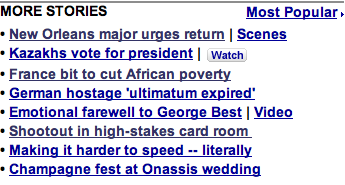
Here's the 'top stories' listing from the main CNN.com homepage this morning. Is there absolutely no quality control whatsoever?

Last week they had a story about the snow and cold temperatures in Europe; they reported that temperatures fell to minus 10 Celsius, and then they said '(minus 23 Fahrenheit)'. Of course, minus 10 Celsius is actually plus 14 Fahrenheit, so they were off by almost forty degrees. I emailed them (yes, I'm that pathetic) and informed them (not necessarily politely, but not utterly rudely either) of their error. I never saw the story changed (yes, I checked).

But this thing this morning seems beyond the pale. They cannot even get the short phrase headlines correct: instead we have a major in New Orleans, and France biting people Africans. I like to check the CNN headlines, just to know what's making the agenda in somethign near the center of American journalism. Perhaps I should give up and just stick to European press.

02 December 2005

Whew!

Can you sense my relief and exhaustion? That's right: this week brought to a close a full four weeks of teaching. It was gruelling, let me tell you. Even worse is the knowledge that I'll have to start up teaching again a mere 2 months from now!

But seriously, while there's less teaching here, it's made up for in many other ways. For example? How about my 90 minute 'admissions committee' meeting today, or the 3 hours of candidate interviews I conducted earlier in the week. All of those things that US University administrations do, we do here through the department - including the entire admissions process. Next week begins the 'marking' period, where ALL of the assesment materials will have to be read by the department as a whole, with 2 markers assigned for every piece of work. Each of us gets a number assigned for the centralized distribution of marking. Mine is 300 and some change, and I've no real idea what that means. I do know that there are 3 to 4 weeks of the year where the entire department is marking full time.

Also, keep in mind that a 68 would be an outstanding mark, a 50 is not too bad, and anything above about a 76 is unheard of.

01 December 2005

My Restraint

I wanted to post a ranting response to this rant, itelf a response to this article on, roughly, the state of feminism and gender relations today.

Instead, I fooled around with the blogroll thingy that Paul set up. I now seem to have it working, but the layout is missing the cool little blogspot bullets. I'm hoping that Rebecca will figure out how to fix that, since on blogroll it looked like it involved css or some other technology that's not my friend.

But I will say two quick things: 1. go read the first article, but 2. please do so with this in mind, a point missed by the ranter: it's not about YOU. It's about the broad ambit of gender relations in society today, it's about an effort to shift and change those norms, and a worry that today they resemble 1955 more than 1985. And, if anything it really ought to be, in this particular case, more about men than women.

30 November 2005

they rebelled

there are many of us with unspoken or even spoken, shouted, freely admitted rituals surrounding our televisions and viewing thereof. these rituals, like all traditions, are living and change, adapt, welcoming in new content, new genres, old stories in new garb. rituals are calming, centering. they ground you particularly if and when you are in transition (for however long that may last). and even when you're not in transition, they help to remind you who you are, where you come from, where you might be going. comfort. And so it is without much surprise that Sam and I have developed a ritual of watching at least one Battlestar Gallactica (new series) each night. What is it about BG that is so compelling? It's not a stretch to suggest that this story has indeed been told before (um, can you say 1980s series? can you say the book of Exodus? can you say 'frack me'?) and yet the way they have put this one together (naturally, many of the special effects guys worked on—you guessed it—Firefly) is unbelievably compelling. Visually, in terms of the familial relationships on board, in terms of the political and societal tensions that go along with being under siege and trying to save your species from extinction. It is the entire package. Plus, the enemy is embodied by blonde leggy hotty, and although she's a bit skinny for my taste, her character is fascinating.

The real reason we watch, of course, is for the "previously" narrative they put at the beginning of each episode. It's right after the Universal studios musical banner, which is also fabulous. Something about the imperial "universal" word curving around the bluer-than-blue globe, from India to Africa, and the horns playing, and the tympany. But then they have this lovely syncopated single note that grounds the backstory, brilliantly illustrated not only by film images but also by this wonderful text that fades in and out in exactly the correct and proper manner:
The Cylons were created by Man
They rebelled
They evolved
They look, and feel
human
Some of them believe they are human
There are many copies
And they have a Plan.

hee hee!

28 November 2005

Zadie Smith, White Teeth

Having finally finished the book listed at the right for the past month or two, I felt it appropriate to join the bandwagon of reviewing such things and share some thoughts.

Apparently this was the unofficial book of the month club book in the UK a few years back, and thus everyone here has read it. Which is good—it's a sweeping tale of several families living in north London (where the author is also from), reaching back into their pasts (and ancestral pasts) and peering into their futures. Oddly, though, unlike sweeping epic sagas of family this doesn't truly sweep: it's more intimate than that, following particular characters through the choices they make and the struggles they have with their own limited worldviews.

It's about feeling displaced, the core element of diasporic living, and about trying to figure out what your culture is when you can't go home again. The families are Bangladeshi, white-white/Jamaican, and waspy mcwasp, and you get this wonderful clashing among them, portrayals of partial friendships that don't quite know how deep to go (or how deep they really are), do-gooder white folk who end up learning more about themselves than helping anyone else, and various problematic religions, from the Jamaican Jehovah's witnesses to the Bangladeshi son's sliding into Islamic fundamentalism to the deluded animal rights group FATE.

The novel is in the vein of Rushdie, in the sense that it picks up his magical realist flavoring without going fully into it (no Gibreel surviving a plane crash here). But certain elements of the narrative and the characterization have that flavor, from the name of the fundamentalist Islamic group (KEVIN) to the over the top self-righteousness of the Reason-worshipping, over-achieving, patriarchal Chalfen family.

My primary critique of the book is that like Rushdie, things are connected in ways one isn't expecting, but unlike Rushdie, here it seems a bit forced. It's her first novel, and it's quite brilliant—nothing glaring at all—but there are passages where I thought it might be better to take some time, slow down, and not try to make the connections so quickly. And other moments in which the slower, methodical pacing of the novel, character development, scene-building, attention to spaces was abandoned with a quick flourish (I'm thinking here of the scene towards the end where the twins finally confront one another).

That said, the book has wonderful sections where she isn't rushing. Her discussion of what it means to be "involved" with someone, someone's family, someone's history is amazing (somewhere between the "v"s it happens); her care and caring for the mother of the Chalfen family despite Joyce's unbelievable blindness to what her actions are truly doing; her portrayal of spaces, from the no-pork Muslim-run pub that serves primarily chips and beans to the differences between rooms piled with expatriate "stuff" and the Chalfen patriarch's office space. I'm looking forward to reading her more recent works, including On Beauty, which was nominated for the Booker this year.

25 November 2005

Michelle Wie
Beats or ties FORTY Male Professional Golfers

If you glance around this morning, you'll find no shortage of the following headlines: 'Wie Misses Cut Again'. The message is direct and simple, though lengthy. It says: 1. Michelle Wie is a failure, 2. Wie chokes under pressure, 3. Women cannot beat men in sports, ever, full stop.

This sort of reporting captures both an essential misunderstanding of golf and an essential, distorted, and ultimately failed attempt to assert male superiority. First, when you miss the cut in golf it means you are just below average. Being .500 in baseball is considered pretty good. Wie was one shot away (and she missed 5 foot putts on the last two holes) from being above .500; instead, she was one shot below .500. This is not a failure. Before Tiger Woods, the top players in the world missed numerous cuts throughout the year; Phil Mickelson missed 5 this year (Tiger, two).

The headlines would all have us believe that Wie has once again proven that women can't beat men. But the headlines fail to mention how VERY close she was to making the cut: the SI story and many others FAIL TO MENTION WHAT THE CUT LINE WAS AT ALL!!!!!!. This is convenient for their framing, since it lets them say, simply 'she failed' but not to let us in on the actual facts of how close she was. Moreover, they also neglect to tell us this: 100 professional golfers played two rounds of golf; a 16 year old girl beat or tied 40 of those 99 other male, adult professional golfers. Hence my headline.

If you took every man in the world who plays golf, Michelle Wie would annhilate about 95% of them; she would consistently beat another 3% of them; she'd be close to the next 1%; and probably the top 1% of male golfers in the world would beat her consistently. Thus, the top 100 players in the entire world can rest easy, knowing that they would consistently beat the 16 year old girl.

But to EVERYONE else out there, to all of those reporters and bloggers producing the headlines about her failure, just keep this in mind, she may have missed the cut, but she would KICK YOUR ASS!

(Sincere apologies for repeated use of screaming all caps, but I really felt like screaming when I read these headlines.)

welsh thanksgiving: redux


cranberries!
Originally uploaded by doppio macchiato.
we had a fabulous and authentic welsh thanksgiving over at Keri and Alan's yesterday, followed by snow this morning covering everything! very exciting. pictures up on the flickr site...

hope those in the US are having a wonderful shopping day on Black Friday, and we'll let you know when we're recovered from the excesses of yesterday...

23 November 2005

a traditional welsh thanksgiving (preview)

Straight from the bog to your holiday table!

Status update

finished:
to do:
The glories of the interwebs have provided me with various ingredients peculiar to Thanksgiving, such as the Ocean Spray Cranberry Sauce, Libby's Canned Pumpkin, and of course French's Fried Onions. Like July 4th, which is sponsored, you will recall, by Old Navy ("oh say, can you save..."), Thanksgiving is branded by French's, Libby's, Ocean Spray, Kraft (for Stove Top) and of course Pillsbury, the geniuses who invented easy to roll out, guess-free crusts. We love those guys. Despite their corporate greed, destruction of America's small farms, over use of high fructose corn syrup, and the like. I mean Stove Top people!

The interwebs also provided me with every recipe with the exception of Jackie and Tim's apples and the phronesis on Liz's pumpkin soup (which she has beautifully adapted from the internet, by the way), and Sam's family cornbread stuffing (which they call dressing, but what can you do?).

I found it fascinating that so many people post their family recipe on line, and even better that the subsequent "ratings" involve really helpful discussions of what worked and what didn't. So you get the phronesis through the web. Who cares if we're bowling alone? We're cooking together!

PS: I also found a site for Dad and engineers everywhere: Cooking for Engineers. I love the charts.

21 November 2005

I have been honoured...

...by being cast in the role of 'Calvino' in Paul's most recent, and (I think) final post on Bayes and doom and odds and such. This will be my final thought as well, as I'm not sure anyone but Paul and I are still paying attention. Still, I needed to say not only that I wept from laughter while reading this, but also that I finally got the distinction Paul was drawing beetween my critique and his. And yes, he was up to something more radical. Indeed, I think his position (with whihc I wholeheartedly agree) undermines the grounds upon which the vast majority of modern social science has been built. Of course, it's no secret that the stars are falling from the sky...

20 November 2005

holla back

I find the holla back nyc site linked above very interesting for a variety of reasons. I believe I got there from this article on Salon.com, where they point out some of the benefits and drawbacks to this sort of thing, but it is a nice intersection of community-building, alleviating the isolation of being stared at/heckled/objectified in public spaces, and the use of the cameraphone for panoptic policing in the hands of those who normally don't have much say in what happens when heckling begins.

In India they call this behavior "eve-teasing" and as in the US, it's not just innocent fun or words or even threats with no physical consequences. It's about fear and the inability even to go to a museum without being chased through it "just to talk." It reminds me of a rather cathartic talk session I had once with four other women who study India--we were in a cab sharing our worst "grope stories" from our research days. Not one of us didn't have one, and some were much worse than I had experienced. But of course it doesn't need to cross the line into physical contact directly--it all affects your physical being, your ability to move around, to dress a certain way (although I found that it didn't matter how baggy my trousers were or how potato-sack-like my tunic was, they still stared), your blood pressure, your psychological well-being.

It also reminded me of an afternoon session on protecting oneself from physical assault run by IMPACT that involved teaching women (and they have some courses for men--the gendered nature of self-defense courses is a bit of a problem) what to do and what not to do in situations where you do feel threatened and thus are threatened. One of the women in the group was younger (high school) and so would talk back in situations rather than attempting to extricate herself. It was interesting because I completely get her feeling of wanting to take back the power by talking back, wanting to rise to the heckles, act like a man, but she ended up putting herself in a more vulnerable position by answering, revealing things about herself, her plans for the night, whatever it was, that then the heckler-cum-attacker used against her. So this hollaback site seems to be a good thing to me. shame a few people, perhaps. not give anything away except that you have a cell phone (and could call someone or the police) and you've taken their picture (thus recording their face for any future legal action).

I can recommend IMPACT to anyone in a city where they do courses--even the few hours I spent there gave me a good sense of what instincts to trust and what not to trust in a threatening situation. The main thing I took away from my short course was the ability to speak the word "No" and have it be heard. They teach you how to break through your politeness training into a forceful verbal negative. In other words, they make girls learn how to shout, once and for all. How great is that?

It would be a great world in which hollaback and IMPACT didn't have to exist, and yet. and yet.

19 November 2005

the odds are in no way 99

I have discovered in the last few days of posting, commenting and discussing that there is a simple chemical equation out there:

me + discussions of statistics ==> stupid me

anyone else feeling this?

I think it was the moment I read the link from OaO's blog that first fateful day that pointed to a helpful explanation of the Doomsday argument, here.

I suppose my problem is this: I'm not good with assuming abstract things and then applying said abstractions to made-up physical, real-world hypothetical examples (that, by the way, are supposed to make it easier). So, for example, when asked whether I'm in the first third or the last two-thirds of humanity, I of course first think: how could one know this? And then I think, hm. Well, the population hasn't been constant at all since the purported beginning of humanity, what with the whole black death thing, the exponential growth post-industrial revolution, and now the leveling off and even negative growth in some wealthier regions. I think about the effects of dentistry on eating habits and life span, the brutal conditions for agrarians in various periods, the fact that Mumtaz Mahal died bearing her 14th child (and didn't that just suck), the nomadic practices of various groups of Mongolians in the 10thc. And so you see: I am an historian.

I get the situated knowledge thing (I've read some recent anthropology, people!) and so it just seems that these questions that statistics asks and answers, or should I say this particular question, strikes me as silly. And it offends me that it makes me feel "stupid" not to follow something so clearly ridiculous as using basic logic and some 18th c. guy's theory about stats to figure out which number human you are. Shouldn't we be more careful with the questions we ask? Is there an ethics of statistics in which certain questions, which may prompt folks to argue about the precise location and identity of human number one, for example, as well as the precise date and time of the end of days/rapture, to be ill-formed? She asks these questions having not herself questioned their ethics?

Herewith endeth the 99th post of our blog.

18 November 2005

Randomness vs. 'Random Sample'

Excuse me, everyone, for using this space for my own education and not for, well, whatever else it is supposed to be for. Señor gadfly writes in the comments:
what it [the doomdsday argument] tells you is that if there are two choices, ten time marbles or a hundred time marbles, you are (much) likelier to be in the former case.
Yes, but it only tells you that if I think that I have drawn myself from a random sample of all possible marbles. Before I draw myself, I have to assume, as a prior probability, that there is an equal chance of humans living for just a little bit of time, or for a very long bit of time. It's only after the sample is drawn (i.e. us) that we can revise to a posterior probability that doomsday comes early. And we cannot make that statistical leap because we are not a random sample.

Finally, and more importantly:

it's 2005 and I'm alive on the earth. What are the odds I'm American? Do the math and you'll come up with an answer that's around 1 in 24, or about a 4% chance. And you're wrong, the Odds Are One™, I am in fact American. Bayes says I should bet on me being not American, but if I were to do so, I'd lose. Don't get me wrong, I think the Doomsday Argument is totally, utterly invalid, but I don't think it lies in deciding whether you're a random human or not, because it seems very difficult to show that this isn't the case, just as it's difficult to show that it is. I think the answer is really more Platonic than that--you and I can't be defined as random human number 60-billion-and-some-odd, because we cannot be separated from our 20th century-ness, our American-ness, our iPod-having-ness.

Two things: 1) I'm totally with the Fly on the notion that we aren't random humans and we can't look back at prior events and say in a meaningful way 'what are the odds that would have happened' when, in fact, they have already happened. The odds are one (can I say that without getting sued? Any chance any lawyers read this blog?). 2) However. Before knowing who you are, you should bet on your not being 'merican. But once you 'sample yourself' as it were, wouldn't Bayes say you should revise your probabilities upward? But the Bayesian logic depends on the notion not that YOU are random, but that if we have chosen you, we have chosen you from a random sample of ALL humans. Bayes isn't even telling us about the odds that you are American. He's telling us, about the chances that there are only Americans in the world, with the prior possibility being X and the posterior possiblity (if you've picked an American) being a much larger X. That breaks out as follows:

A. If I say, I'm going to pick a human being (not me) at random from the billions of us out there, then the odds are 1 in 24 that I will pick an American.
B. If I say, what are the odds that I'm American, then 'the odds are one'.
C. If I then say, from out of the entirety of human history (forward in time until its end) what are the odds that I would pick someone who has lived prior to 2005, then the odds are slim. However, to then sample from the population alive today, I break the primary rule of statistics, in that we are not a random sample of all humans.

What I'm trying to say - if anyone still cares by now – is that point C and point B are very much distinct. The Odds are One (point B) is an argument about how we aren't random humans, and about how we can't look back in time and attribute statistical probabilities to things that have already happened. Point C is merely the assertation that we can't sample from the PRESENT and presume it is a random sample of ALL TIME, because we aren't living at the end of time.

On the other hand, maybe the Fly's point is simply beyond me, and involves something far past the simple Bayesian logic. But I still think that Bayes tells the Fly nothing about his being an American, until after he has found out his IS American, at which point Bayes and the Fly agree, in that the latter says 'the odds are one' and the former says, 'we do not have a random sample any longer, so my logic does not apply'.

17 November 2005

Temporality

Paul is at it again, making me and others think about statistics, and analytic philosophy. Damn him, doesn't he know that if I wanted to think all the time I would have wasted the last decade or more trying to be an intellectual?

I've never studied the Doomdsday Argument, because I've never done serious analytic philosophy but more importantly because (after looking at the argument) I think I got a better training in statistics than all that. In other words, it seems to me that one does not need to make a philosophical critique of the argument, because it's based on an utterly invalid application of Bayesian statistics. Bayesian theory tells us that we can revise prior probabilities in light of new information. Like most probability theory it relies heavily on the idea a random sample. This paper that Paul linked to is actually much clearer than the link above. It gives the example of balls in an urn: if we don't know if there are 10 balls in the urn or 100, then our prior probability is .5 for each possibility (10 or 100). If we then pick one ball out of the urn and it turns out to be numbered 1 through 10, we can revise the probability of there being only 10 balls upward (since the chances of picking 1-10 if there are only 10 is much higher than picking 1-10 if there are 100). Fine by me. Go Mr. Bayes.

The Doomdsday argument says we can apply this reasoning to the population of the species. If you sample US - that is, the human population today - we seem to be the 1-10 balls, increasing the chances that there are only going to be 10 or so balls, ever. But we aren't a random sample of the entire history of the human species! I don't know if it's bad philosophy, but it's awful statistics. If we went to the end of time, when the human species was extinct, then sampled from all of human history and picked one of us that would tell us that there's a good chance humans didn't live very long. But we are not at the end of time, we are in time and we always will be. Sometimes we want to freeze things to look at statical samples, but we can never do that with humanity as a whole and certainly not with the future history of humanity.

Part of the problem with applying statistical theory more broadly - to thinking about human problems, politics, history, the world, etc. - is that it has no space for a sense of temporality. It is either completely static, or it moves through points in time in the most fixed and linear sense possible. Statistical reasoning is almost always very contrained by its prior assumptions of a random sample (and others). And the world we live in is filled with patterns and choices that make it only rarely a random sample. The world (and us) is marked by a temporality that will always thwart our own efforts to fix that world in place with logic.

16 November 2005

the sand


the sand
Originally uploaded by doppio macchiato.
the last two weekends one or both of us has walked from our place in Sketty to the Mumbles, which takes about an hour and 15 minutes or so, depending on how fast you walk. when I did so two weekends ago the tide was out, hence the pic. it's quite dramatic when the tide is out, as you can walk directly across the bay to Mumbles rather than taking the path around the bay. that is, if you're brave and know the tide timings, which I do not.

14 November 2005

elevation: hilly or flat?

the first song on my ipod's "running #1" playlist is U2's elevation. I usually put the ipod on shuffle, so songs that follow vary, but the first one is always elevation. and the first part of my chosen running path is this serious uphill climb, going from our place away from the water on a sidewalk that is just this side of needing to be steps.

and so, as I get my bloodrate going by pounding up this insane slope (Sam confirms its insanity, by the way) I'm listening to elevation. and it is interesting musically in that neither the words nor the music really go "up" in any real way. Yes, there's the interval between "a" and "mole" in the chorus, repeated several times, but it's ironic that the one upward movement in the music fails to match the lyrics: "a mole, diggin in a hole, diggin up my soul now goin down excavation" primarily a downward, hole-digging lyric, no? and when you get to the denouement of the song, where the Edge is doing his thing and Bono is in falsetto it's all moving down the scale. and so my question.

elevation: hilly or flat? discuss.

11 November 2005

in search of an axiom

yesterday, as you will recall, I posted that two boxes remained missing from our group sent from Redlands. we listed what was in the boxes, or what we thought was in there, sympathy abounded, no one got to go shopping, etc. etc. and then today, in an act that I can only describe as karmic, the boxes showed up! and my thought was that this deserves an axiom or law of its own: not the whatever can go wrong will, because that's clearly not what's happening, boxes or no boxes. but more along the lines of: as soon as you give up on something, it will appear at your doorstep. okay, okay, not the cheesy: if you love something set it free thing, but more in line with the material goods aspect of this experience. as soon as you order a replacement credit card, yours turns up in the dryer. as soon as you replace all the locks in the house, your lost keys show up in the basement. that sort of thing.

I looked for such an axiom on line and did not find one. I did find several that I find hilarious, including Huminston's Law: When you are up to your ass in alligators, it is hard to remember that your original intention was to drain the swamp.

and I went over to Katharine's quotegeek site of yore to see if I could find anything, only to get sidetracked re-reading the quotes from My So Called Life. What a great show that was, no?

I'm happy to report that the pieces of suiting, corduroy jacket, entirety of Sam's dress shirt collection, his Minnesota Golden Gopher hockey sweater (!), the professorial-patch sexy wool sweater, several items I was sure I'd given away, and perhaps most importantly our sheepskin slippers were all there. very exciting.

and now I can stop watching for the delivery truck (o-o the wells fargo wagon is-a, comin' down the street...)

10 November 2005

murphy's law

it has been almost three months since our good friend Joel spent precious time carrying our boxes to the post office in Redlands and mailing them to us. And we have received seven of the nine boxes he mailed, as well as all of the boxes Liz, Simone, and Mom kindly mailed from Denver, which contained our books, so as academics that's key. But of course, the two boxes missing contain some interesting and crucial items, things we've actually been missing despite the fact that even having sent less than 20 boxes o' stuff, we *still* have too much crap.

One box is Sam's clothes, one box is mine. In Sam's box (we think) we are missing the cold-weather running pants and shirts and his mid-weight corduroy coat, all of which would be perfect for this weather, of course. In my box I'm missing my entire black suit, the upper half of my new JJill suit (don't ask why I separated it—you try packing for a hypothetical move 4 months in advance), a lovely mid-weight London Fog coat, and my red wool turtleneck with the obnoxious elbow patches that reference old professors just enough without taking away any claim to "sexy young woman" I might still retain.

Our friends in Edinburgh had a bit more of a chaotic departure from the US and thus don't have a precise count of their boxes but we both suffer from this nagging feeling of: where is that thing? Did we leave it in storage? is it on the Atlantic somewhere? did these two boxes get diverted via New Orleans before the hurricane? did I give that away in a fit of puritanical, anti-materialist rage?

And then the last thought: does this mean I get a fun shopping spree for new stuff??

09 November 2005

Bill Maher Gets It

Our 'Chambers production' Gopher Hockey games have been arriving with DVD Bonus material, in the form of episodes of Bill Maher's HBO Show Real Time. Thus, we're watching, but we're a few weeks behind (everything in the UK is a few weeks, to a few months, to a few years behind the US).

I disagree with Maher's positions about 30% of the time, and I disagree with the way he articulates them a majority of the time. But there are a few issues on which he really just 'gets it' in a way that the mainstream of American politics never seems to be able to do. I would include his tirades against the food industry (and the obesity epidemic), as well us his positions on the environment in this category.

Most suprising of all, though, may be his sexual politics. Maher is a middle-aged straight man who is not married and does not want to be (ever!), and one gets the sense that his sexual appetites are varied. In short, with respect to the dominant sexual norms, Maher is queer. If this sounds far-fetched, then I provide as evidence his 'new rules' from 14 October. Maher says that the 'real reason' the right couldn't handle Harriet Miers had nothing to do with her 'qualifications' or her positoin on Roe. The former never bothered the right in the past, and the latter really was assured (a Catholic who is born-again as an evangelical just isn't pro-choice folks). What really bothered the right about Miers, then? They couldn't make sense of or accept her (a)sexuality. As an unmarried 60 year-old, says Maher, Miers was either celibate, gay, or a slut – in other words, once again, queer with respect to the heterosexual norm. Go read the whole thing.

08 November 2005

superstore

the writing is getting a bit easier, linked to a newfound arrogance that involves me acknowledging to myself that I actually do know this stuff and have a mastery over it, despite its breadth and general insanity. I am halfway through and have worked in the Maori tattoos, Robert Smithson, the Norse stuff, the Stele school of Chinese calligraphy, Bierstadt, Indo-Caribbean performance, Hawai'ian quilts, and the Elgin marbles.

more importantly, however, is that I have placed my first on-line order for Tesco, grocery superstore, to deliver groceries to my door this evening. specifically between 9 and 11 pm. I will report back on the outcome. I am currently debating whether or not to tip the delivery person, and if so, how much. I'm leaning towards yes, and £2...thoughts? too chinsy? makes the person feel cheap to tip them? hm.

07 November 2005

know when to stop.

writing is difficult. I am rediscovering this as I write an entry for the Oxford Encyclopedia of the Modern World (modern = 1750-present in this case) entitled "Art—Overview." Art. All of it. 1750-present. I could cop-out and write it as the story of art historical progress from Romanticism through the Neo-Classical and Realist periods, on to Impressionism, the Modern movements (Surrealism, Cubism, etc.), Pop Art and Abstract Expressionism, and The Postmodern. And yet, I am not that guy. I'm the fool who wants to solve the world's problems in an encyclopedia entry. thus I am attempting in 3000 words to do justice to "Art—Overview" on a global scale, including the practices of tattooing by the Maori, sculptures of deceased twins in western Africa, Qing ceramics, Hiroshige, the revival of Norse mythological subject matter, the folk art of the Appalachias, Socialist murals in Mexico, Stalinist propaganda posters, and of course, the musical sculpture of Tipu's Tiger, made in advance of the southern Indian king's victory over the British, a victory that in fact never happened.

I am slogging through.

After writing about 450 words this morning on the period 1750-1880, I penned (typed?) this glorious two-sentence summary of Orientalism.
This period also saw the birth of Orientalism, or the construction of an object (“the Orient”) that could be studied by Europe. The Orientalist genre of European painting spans the stylistic movements of Romanticism, Neo-Classicism, and Impressionism and focuses on the cultures of northern Africa and the eastern Mediterranean, depicting scenes that supported the idea of the Orient as place of lasciviousness, barbarity, and sloth populated by inaccessible scantily-clad concubines, ruthless warriors, and indolent sultans.

and we're done writing for the day.

05 November 2005

doings

ostensibly one of the reasons for the blog is to keep friends and family far away up-to-date on our thoughts and doings. thoughts, we seem to be doing well on. doings, not so much. so herewith, a brief synopsis of our day-to-day:
  • we are happily watching Battlestar Galactica's first full season, having finished Gilmore Girls' fourth season last week. GG's ending was traumatic, but had that wonderful mix of horror, mourning, happiness, excitement, and humor that GG on good day can deliver so well. BG is exciting and intriguing.
  • we are also very excited that Jon Stewart is on More4, the new station that launched in early October. we are sad that we don't get to see the Colbert Report as well. can't have everything...
  • went to the boot sale again today (we don't go every weekend or anything) with three specific goals in mind: 1. drop off empty egg cartons to egg guy who is always asking for empty egg cartons. 2. buy a beard trimmer for Sam. 3. buy some sort of exercise bike such that we can work out when it rains, which turns out to be fairly often. As you may know, attempting to purchase anything purposively at a boot sale/flea market is folly. Folly! And yet, we succeeded on all three counts, including having the exerbike delivered to our doorstep by friendly Welshfolk (we told you they are friendly!!)
  • it is chilly. we are cheap. we have begun turning the heater on in the front room for 15 minutes or so each night, which warms it up nicely (this is why they invented doors, my friends. open-plan living is not so great for chilly). we have central heating only in the sense that the on-off-switch is in one place, near the water heater. no thermostat, so we just turn it on full-blast, turn off the radiators in rooms we're not using, and voilĂ . somewhat toasty.
  • have thus far tried over 6 different varieties of sausage at the local butcher. a sign there read: "pork, prune, and apple sausage: try it, it's awesome" I kid you not. Minted lamb burgers still the best burgers ever. New international market opened down on St. Helen's Road, with the most beautiful okra you've ever seen. Eid Mubarak all around, folks.
  • we have discovered the health stores in city centre which stock natural peanut butter by the tub. yes, just like those old school ice cream tubs we used to get... remember? imagine that filled with yummy crunchy peanut butter, no sugar, just peanuts. heaven.
  • Tim and Jackie send us DVD packets each week that contain the previous weekend's Gopher games, expertly edited by Jackie on the TiVo. We get instant replays, pauses to view the stats tables, and all the commercials edited out. Fab. it's like watching it with them. only a week late. so no spoilers!
  • Sam's job continues to go well; he has his first intensive teaching this week, and we will report on the whole "tutorial v. seminar: what's the difference?" debate.
  • I will be teaching a 2nd year module (trans.: sophomore-level course) in the spring entitled "Colonialism and Nationalism in India" in the Politics department. this means I have transitioned from humanities softy to hardened social scientist! I'm very excited. I plan to do a week on "the clothing of nationalism" which will involve study of the Nehru collar, the Gandhian dhoti, spinning, and fashion in general. should be fun...
  • I interviewed at Open University in Cardiff, but they didn't have work for me despite liking me quite a bit. perhaps something will come up later on. attempting to keep the faith there. I'm going in to chat with the fine arts department at Swansea Institute in a few weeks about possibilities there.
  • signed up for a library card at Swansea public libraries. they rent DVDs and CDs, which is very exciting. Libraries in general are exciting, wouldn't you say?
  • we may go to see the film director and writer Peter Greenaway of The Pillow Book fame talk next week as part of the Dylan Thomas festival here in town. the Welsh stick together, I think.

    and the usual working, sleeping, eating, of course. and walking. lots of walking.
  • 04 November 2005

    learning from your mistakes

    what I love about Catholicism is its long view of history and its awareness of past mistakes (if not present ones, but they will, eventually, become past mistakes and thus the Church will become aware...)

    referring back to our earlier musings on evolution, I ran across this AP wire today which details the Vatican's on-going discussions about evolution:
    Monsignor Gianfranco Basti, director of the Vatican project STOQ, or Science, Theology and Ontological Quest, reaffirmed John Paul's 1996 statement that evolution was "more than just a hypothesis."
    "A hypothesis asks whether something is true or false," he said. "(Evolution) is more than a hypothesis because there is proof."
    first of all, what an acronym! second of all, anything with the phrase "ontological quest" has my vote. third of all, I love that the Vatican has a website for STOQ and that the papacy clearly is in the age of the internet, while they also, in the same AP piece, referred to earlier mistakes in the on-going discussion between religion and science, mistakes they regret, such as the whole Galileo "thing":
    The Vatican project was inspired by Pope John Paul II's 1992 declaration that the church's 17th-century denunciation of Galileo was an error resulting from "tragic mutual incomprehension." [...] "The permanent lesson that the Galileo case represents pushes us to keep alive the dialogue between the various disciplines, and in particular between theology and the natural sciences, if we want to prevent similar episodes from repeating themselves in the future," Poupard said.
    what I love about this is that it's not like the Galileo case is new news, and yet, in Church Time, it kind of is. Perhaps the longevity of the Catholics might be a lesson to those claiming Christian status and behind the whole intelligent design thing. But I suppose that would mean learning from history, or even knowing history. oh well.

    03 November 2005

    "Odds Are One" 2ndAmericano Style

    As I've suggested in the past, I know that Paul's not just talking about statistics, or math, or programming when he's talking about...well, statistics or math or programming. After some political theory reading this morning, I'm better able to specify that intuition. Here's what I read:
    ‘in our personal lives [as in human history] our worst fears and best hopes will never adequately prepare us for what actually happens—because the moment even a foreseen event takes place, everything changes, and we can never be prepared for the inexhaustible literalness of this "everything"’ (Arendt 1994). Her point is that when an event passes from possibility to actuality—regardless of how probable or improbable we may have taken it to be while it was still only a possibility—something changes in a different register; namely, the register in which happenings are not only caused states of affairs but also meaningful events, features of a world, and, in particular, occasions for response.

    02 November 2005

    politics of the everyday

    I suppose as a response to comments on my earlier rant regarding the topic: "Feminism: still relevant? still useful? discuss." and given that others too, seem bothered by the post-feminist assumption that we're over it already, or perhaps even more to the point: get over it already, I wanted to note a particular tenet of mine. Which, in the end, relates to the religion/faith discussion we had earlier. I'm also prompted to link to the even earlier discussion about how there is only one narrative, really, and here we are again.

    Yes. Hilary in '08. Absolutely. Hilary-Obama or perhaps Obama-Hilary. mix it up a bit. but as friend Dan knows quite well, the political also occurs on the everyday, minute level. the level of: here's who I am, and I'm not going to be cowed by your assumptions about who I am into being someone else. this goes for being gay, a woman, or just in general queer. and by that I don't mean gay. I mean undercutting the norms in general.

    So if that means speaking your mind in a meeting, interrupting or cutting off someone else in a loud voice, even if you don't have a penis (sorry Mom—so hard to say that word in front of your Mom, no?) then that's what it means. And yes, it's not a battle that one signs up for. Or gets paid to do. It's a daily, groveling, crap battle that demands nuance, respect for others, wit, and a generosity of spirit. Often, it is fought by those with cynical, small, close-minded ways who demand others bend to their will, or risk being labeled "fascist." [Sam and I call these types of people, usually left-leaning and well-meaning, "close-minded open-minded people"] but one hopes, for the future of the universe, that it is fought from the generous side of listening but then also arguing for what is, fundamentally right. Like equal opportunities for each person, the right to work for a living wage, the right to maintain one's health without breaking the bank, the right to speak your mind in meetings or on the web regardless of the expectations of gender or race or class. These are things that we do not yet have. Perhaps will never have. And yet they are still important to argue for and stand up for. In a generous, open way, but one that promotes debate and discussion not: I'm okay, you're okay.

    so it's not about squashing others' opinions, it's about fighting for something that is right. And everyone's opinions are, in the end, not equally correct or right. one only needs to read a few undergraduate papers to learn this universal truth. we need to stop looking at the sexism thing as about individuals, individual choices, or individual opinions. it's not about blaming some single person, it's about recognizing the atmosphere of misogyny and ameliorating it where we can. it's a systemic, all-encompassing sludge that we are all in: women, men, transgendered, and the rest. our job should be to try to clean up this sludge one molecule at a time.

    (don't know where that metaphor came from. sorry about that. damn you metaphors!)