19 March 2007

Pan's Labyrinth

The Oscar hype and curiosity about a politically-engaged fantasy film drew me in to the excitement surrounding Pan's Labyrinth. We watched it on DVD this weekend, and I have to say, er, not so good. Not that it's not beautiful. Not that it's not wonderfully shot. It's entertaining, sure. There is nothing new here to learn. This is my problem. Not that films should be didactic--they shouldn't set out to teach--just that there should be some synthesis that they perform that opens up a tiny new bit of insight for the viewer.

I know next to nothing about the Spanish Civil War except that it happened and a bunch of French and American intellectuals attempted to led their overly pampered hands to the fight against Franco. I don't know much more about it now, either.

I have learned: fascism = bad. rebels in woods = good. torture = bad, but pornographically voyeuristically (supposedly) fun to watch (ick). people, particularly evil ones, are often sexist. children are our future. watching blood and guts slowly implode = cool (ick). violence is beautiful (ick).

It seems that filmmakers have realised that the audience is desensitised to violence. Instead of finding another way to articulate the horror of violence, power, and war, they simply make the violence more and more hyper-real. It's not realism. Realism is the fist fight where after the first punch the two people are groveling in pain on the floor, and half the punches don't land properly, and the two individuals aren't built like Mr. Universe. What we have in Pan's Labyrinth is hyper-realism: a fantasy world of pops and fizzles and hands cut open and amputations and sewing up one's face. Perhaps the message is that Franco's Spain is a fantasy world just as the world the child constructs in the film is also a fantasy world. Or that both are equally real.

If that's the message, which is fine, and I would be excited about, except that it's done incredibly poorly. Why are there no links between the underground fantasy world and the Franco world? I'm talking narrative links, metaphorical links, intertwined 'tasks'? The two spaces don't overlap narratively--it's the old two 'intertwined' narratives that don't ever quite speak to one another. (This seems to be a pattern in contemporary filmmaking. See David Denby's brilliant piece on this in the New Yorker.) So we have a (children's) fantasy film interspersed with a film about Fascism's badness, and neither really works.

I decry the lack of art in this film: I have seen this all before. In the other Labyrinth film, for example. (an unfair comparison, obviously, as any David Bowie film will of course beat any other non-David Bowie film. duh.) In the violence of the clips from 300. This isn't helping us to see how condoning torture is hurting our society. It isn't helping us to see how living in certain authoritarian regimes utterly changes the power dynamic and thus forces good people to do things they wouldn't otherwise do. It's not a study in politics or psychology or war. It's a pornographic exploration of violence and evil. We don't need that. I'd love to see this film again, except this time make the evil guy human and complicated. Show us why everyone follows him. Why does the mother marry him? Explore some of the class issues barely whispered in the film. Link the fantasy elements more clearly and directly (yet subtly) with the 'real' elements. Make the collapsing of the two explicit and do it for a reason. Don't show us the violence through special effects--make us feel it through the crackling of it in the dialogue.

And please don't smuggle in some half-baked God the Father glowy stuff at the end. Please.

Next: Real violence...Dogville!

11 March 2007

speed

I mentored a senior thesis when I was at Redlands--a time when I mentored a whole range of things completely unrelated to my research, and so this thesis was on the Futurists. I learned a lot about these speed-loving Modernists: pro-war, excitement, strength, and masculinity.

Upon my groggy return from the US this past week, I taught Gandhi's Hind Swaraj. He argues among other things, that railways are bad. Humanity should not be able to move that quickly between places. It destroys what binds us together. It destroys community and a link to one's past.

Obviously as an Australian-born naturalised US citizen of Scottish-Austrian descent now indefinitely residing in Wales (sut mae!), and with family and friends currently living in Ulaan Bataar, Brisbane, Beirut, Delhi, Portland ME and OR, New Jersey, Denver, LA, Taipei and etc., the whole transcontinental flight revolution was pretty cool. Facilitating these far-flung travels, worldliness and global network of family and friends is a good thing.

But having spent less than 10 hours in the air in order to travel from LAX to LHR, I have to say: it's too quick. How slow should it be? Not the 3-6 month era of slow cruises across the Atlantic or Pacific, sure. But a good 3 weeks. I think that's entirely fair and reasonable. This is how much time it should take for the universe to be, well, in tune with the body's movement in some small way. Now that I'm old and all, it's taking me a long time to recover from these little jaunts. But mostly I find it Wrong that I wander around reading Welsh roadsigns thinking: 16 hours ago I was driving to LAX on the 105 listening to Mexicana music. Wrong.

02 March 2007

(shhh...) Wagner was.....
A Cross Dresser!

The above-linked Guardian article is truly disappointing. It has to work really hard to build up the salacious lather it's striving for, over the 'discovery' of some letters in which Wagner went into baroque detail describing women's clothing. And for the big climax the article 'reveals' that Wagner ordered some custom-made dresses, about which he had very specific requests and concerns. He himself said these were for his wife, but she never noted their receipt in her diary....so....maybe they were for him!

A few comments on this nonsense:
  1. As to the detailed and flowery language: um, it's Wagner we're talking about. What the the hell would you expect?
  2. As to the fact that he might have worn dresses, or liked 'girly' things. I see no reason for historians not to write about this, but how is it news? (I know, the weather is news, so I guess anything can be.)
  3. Finally, there's the fact that the article consistently turns 'cross-dresser' into some sort of 'secret' identity. One Wagner might have tried to hide, but that we, today, can reveal. It's not an account of Wagner wearing women's clothing (because we aren't even certain that he did that); instead, it's a CSI-style investigation of his possible identity. Maybe he WAS a cross-dresser? Or perhaps he was a martian?! If they were giving this salacious account of his potentially being gay, then the homophobia of it all would jump right off the page. But if it's 'merely' 'gender deviation' then it's OK to make the whole thing out to be perverse and deviant. But the idea of gender-deviation as perverse or wrong is of a piece with homophobia: both are products of heteronormativity. In both cases we have this rigid effort to uphold gender binaries, and this is, in a way, made easier by the so-called acceptance of homosexuality not as a practice or a way of being in the world, but as a 'sexual orientation'.
But, to revert to a liberal language that I'm trying hard to avoid above (and that I'd never use in formal writing): who gives a shit if Wagner liked wearing dresses? Why is that so damned threatening, and therefore morbidly interesting, and therefore newsworthy? Why do we work so hard to separate masculinity from femininity?

It's too bad that Rebecca herself isn't nearly as girly as the heteronormative order would like her to be, because, nonetheless, I'm heading upstairs to raid her warddrobe and get myself dressed up!!!

27 February 2007

Take 3

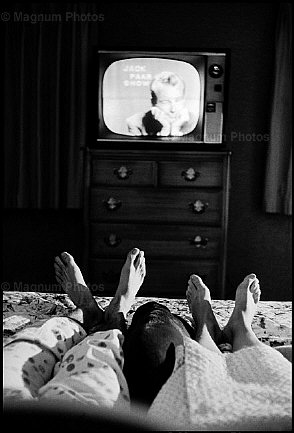
All of you who exlaimed, in response to my choice of book cover, 'but there's no TV in it' may well have missed promising careers in sales. That's precisely what the sales people at the publisher said. Thus, the search continues.


'Anonymous' reader was kind enough to send in a number of images with TVs in them. Sorting through that list, I've come up with a few possible candidates. And since this has been a joint project all along, I thought I'd solicit advice one last/more time.

What do you think any of these?


25 February 2007

I shouldn't....but....a couple of questions re: Israel

Given the way things blew up over at Ffb during the debate over Carter's new book, it is with some trepidation that I pose questions about the state of Israel. But I'm not trying to provoke. I'm genuinely a bit confused and would love to hear responses from ye brilliant readers.

Richard Cohen, in an article about the dilution of the charge of anti-Semitism, writes the following:
[...concerning] the current, ahistorical context for Israel. For many, [Israel] is no longer the orphaned waif of the Holocaust [#1] but the bastard child of Western colonialism [#2].

My questions:
  1. Semantics: does 'orphaned waif' just mean orphaned orphan? Come to think of it, doesn't 'bastard child' really just mean bastard?
  2. Logic: aren't #1 and #2 completely compatible? Can't the state of Israel be both a product of the holocaust (a response to its horrors) and Western colonialism (a creation of its errors and crimes)?
  3. History: why would thinking of Israel primarily through the lens of #2 be ahistorical compared to thinking about it through lens #1 – doesn't he have it exactly backwards? Doesn't the history of colonialism give a broader and deeper context for understanding the plight of European Jews and the creation of the Israeli state? Isn't the simplistic idea that Jews were 'given' the state of Israel as some sort of 'compensation' for the Holocaust a more ahistorical way of looking at the situation? Isn't this the view that extracts from history and context, the view that considers the situation as crime and recompense in a timeless, ahistorical sense?

23 February 2007

Music and Politics. But mostly music

Thanks to my mom, who was (rightly) concerned about my well-being while Rebecca traipses across the world, I'm currently watching the Dixie Chicks performance on Austin city limits. I thought Taking the Long Way really was one of the best albums that I listened to this year, so I was pleased to hear the Chicks raked in all the Grammy's. But I hadn't paid close attention to the details or to the current status of the political conflict that continues to swirl around the Chicks.

But after already impressing me by playing a spot-on version of Patty Griffin's "Truth No. 2", the Chicks really blew me away by playing a song that I'd never heard before. I thought it was called "I'm still here," but googling got me nothing on that. Turns out the song is called "The Neighbor" and was recorded for the documentary movie (about the controversy), titled Shut up and Sing.

At any rate, the google search revealed a few other juicy tidbits (I got them here):
  • After the Grammy's their album has jumped up to No. 8
  • "Not Ready to Make Nice" is the no. 4 single
  • No other group has ever won the Grammy award for Best Country Album more than once
  • The Dixie Chicks have won it for every single album they have ever made (4)
I did some other reading as well and it's clear that the country music industry remains committed to their boycott of the Chicks. They've had to cancel a number of shows, and country radio stations refuse to play their music or sponsor the concerts. But it doesn't matter much when it comese to the music, which is clearly better now than it ever was when they were trying to fit into the Nashville country genre. For anyone who doubts this, please get your hands on this Austin City Limits concert (or go see them live), so you can hear their cover of Dylan's "Mississippi".

22 February 2007

18 February 2007

speaking of book covers

in searching for a penguin book, I ran across this flickr site, which is very very cool.

http://www.flickr.com/photos/joekral/sets/72157594264351021/

check it out.

17 February 2007

not quite right

For Christmas, I received a loverly camera from Sam, which takes fab photos, walks the dog, does the dishes, and makes dinner. Really. Okay not any of those things except for the first one.

When one buys a camera one is then, naturally, forced (forced!) to purchase necessary accessories for said camera. I mean, you *need* the perfectly formed and sized case to keep all your memory cards in, right? and the remote control--ya gotta have a remote control for your camera, right? and the tripod, and the self-correcting zoom lens that adjusts for the natural wobble (those babies cost upwards of $2000, but I mean, these are needs, right?) and a flame thrower. because you gotta have flame throwers.

Okay, so I didn't succumb to the initial buy-fest that often follows the first purchase of new gadgetry. But I do need some sort of case. I have, of course, a philosophy on camera cases.

  1. it should not look like a camera case. the reasons for this are obvious: a) camera cases are ugly, and 2: camera cases say to potential thief: hey, dude! camera inside, probably a nice one too, since the dude that owns it bought a nice case for it! As I am not a professional photographer I don't need all the pockets and unsightly things that hang off the edges of said camera cases, and thus, no.
    interesting corollary: camera cases tend to look like camera cases. seems obvious, but doing a froogle for camera case does not, in fact, find you a case that looks nothing like a camera case. strange.

  2. it should protect the camera

  3. it should be quickly and easily removed so that it's not a 20-minute process to get the damn camera out.

  4. it should be small enough so that it can slip into another bag or backpack that one is carrying.


As you can imagine, this thing doesn't exist. obviously. none of the cool things exist. aside from the iphone, peets coffee, and google.

I was using a lovely, small velour purse to carry my former camera around--it held an extra battery and snugly fit the camera on top of that. Brilliant.But I now have a digital SLR with lens etc. and it won't fit into said purse. What to do? I realised that I should just search for 'bag' and see what I found. after fiddling with various search parameters (pretty camera bag; small camera bag; bag -camera +cool +stealth) I found the solution. The Roadwired wrap. I have yet to receive it, but it looks perfect, with the one exception that I'm unsure how easy the ingress-egress will be. I will report when I receive.

This got me thinking about my rigid and difficult requirements for things: must have a computer case that protects the computer, fits it like a glove, is easy to use, fits inside other bags, and looks professional (and not in a messenger bag professional way). it must be light and ergonomic such that I don't hurt my back or shoulder carrying it around. it shouldn't look like a computer bag. oh, and it must last for 10+ years and be flexible to the next computer I buy. sure. for £200+ I can set you up with something lovely. Sigh.

Oh, and for those wondering: yellow. of course.

16 February 2007

the sacred text

my lecture on decolonisation caused another small ripple in the time-space continuum of the debate over citations, texts, and what's considered completely legitimate to do in the context of citing existing research, words, and writing.

Via FFB's post, I read Chalmers Johnson's piece on Empire v. democracy, Iraq, terror, occupation and the colonial relationship between Iraq and the US. The piece was good, and the quote from Arendt was brilliant:
In her book The Origins of Totalitarianism, the political philosopher Hannah Arendt offered the following summary of British imperialism and its fate:

"On the whole it was a failure because of the dichotomy between the nation-state's legal principles and the methods needed to oppress other people permanently. This failure was neither necessary nor due to ignorance or incompetence. British imperialists knew very well that 'administrative massacres' could keep India in bondage, but they also knew that public opinion at home would not stand for such measures. Imperialism could have been a success if the nation-state had been willing to pay the price, to commit suicide and transform itself into a tyranny. It is one of the glories of Europe, and especially of Great Britain, that she preferred to liquidate the empire."

I was excited. This was well-stated. I would use it in my declonisation lecture to demonstrate the debates that went on in the metropole and the ethics of colonialism for democracies. But, Johnson had only given the book reference--to a book that's 500+ pages long and published often in three separate volumes. Google book it, you say? of course. I did. Unfortunately it's only in snippet view, but I managed to came up with this:

Arendt, Hannah. 1966 [1951]. The Origins of Totalitarianism. New York: Harcourt Brace Jovanovich.
p. 216: ...'"administrative massacres" could keep India within the British Empire, but he knew also how utopian it would be to try to get the support of the hated "English Departments"

all other phrases that seemed like good bets turned up nothing. Seems Johnson quoted Arendt via some sort of bizarre paraphrase. Maybe his notes got mixed up. But that's not cool. It's like putting words into someone else's mouth. What if Arendt meant what she said within a particular context of a specific person she discusses on p. 216, and not more broadly as Chalmers Johnson had implied? Hm.

I google further. Google classic this time. I find about 20 references to Johnson's piece in the blogosphere and then the link to victory.

It's not in Origins of Totalitarianism. Here's the correct citation:
Arendt, Hannah. 1958. 'Totalitarian Imperialism: Reflections on the Hungarian Revolution'. The Journal of Politics vol. 20, no. 1 (February), pp. 5-43. JSTOR link, for those with access.

The quote is on p. 35.

At least Johnson didn't make it up. At least they are, indeed, Arendt's words. I was going to blog about the sacredness of the word--the fact that prose often is chosen as carefully as poetry and one shouldn't just paraphrase and then put those words back in the text as if they are actually there, in that order. Just because it 'sounds about right' for Arendt doesn't mean it's okay to do this.

But now it's just a post about sloppiness. Citing properly is important if people are to follow up on your research--not just to check its vailidity but to read more. To engage in the web of knowledge that supported you to get to this point. That's why links in blog posts are so important and such a crucial part of blogging. It seems, however, that sloppiness is okay now. or perhaps engaging with your source's sources isn't something people do anymore. maybe no one else wanted to see the larger context for Arendt's quote. Wow. now that's sad.

Because maybe it's important to know that Arendt is praising the British in light of the Soviet actions in Hungary in 1956. Her work is, from the little I've read, very historically grounded, and thus this context seems important. But perhaps not. Maybe I'm just being nit-picky. I firmly believe, however, that knowing how knowledge is produced is as important as the knowledge itself.

15 February 2007

Cover Time, take 2


Terribly sorry for the pathetic lack of blogging in February. I've been working on that book, which I mentioned a while back, and it's been hard to keep my head above water. I've drafted the penultimate chapter, and then I put together a paper on it, which I gave in London last week and will give here next week. It turned out this chapter had to be about Buffy and thus the massive Buffy literature meant a lot of work for me. Worse still, I made the fateful decision to finally go multimedia, so I've spent dozens of hours deep in the bowels of Keynote, doing everything in my power not to turn into the evil Powerpoint drones that I have cursed so over the years.

Anyway, those are all excuses. This post is about what I hope will be success in sorting out my book cover. Another round of thanks for all the great ideas and feedback from readers last time round. Turns out it's much harder to do a 'concept cover', as my editor called it (perhaps somewhat disdainfully), than we had all thought/presumed. So I wasn't able to use most of the fantastic ideas, since the 'system' is really just to send them a cover and let them go with it.

But I think I've found a cover. What do you think?

13 February 2007

surrealism


So we went to the Tate Modern last Friday, which was fun. We were in London because Sam gave a paper at Goldsmith's college and I used the opportunity to network a bit with colleagues on Thursday afternoon. Friday was ours, and hence the Tate Modern. I'd been there (for v. important exclusive workshop in the 7th-floor East Room overlooking Wren's sub-par (according to Sam, and well hard to disagree) cathedral and the rest), but I had not actually visited the museum before. Despite my training in art history I am not a museum lover. I've decided (today) that upon re-reading Timothy Mitchell's excellent article on Colonialism and the Exhibitionary Order (in Nick Dirks' Colonialism and Culture) that it's about the unending spectacle. One must be actively seeing/viewing/voyeuring in a Museum. this makes my eyes water and my back hurt. I get the sniffles from the AC. I last an hour, hit the gift shoppe (to purchase some souvenirs in order to commodify and thus make material my viewing experience) and go out into the equally exhibition-like world. sigh. Read Mitchell's piece. it's awesome.

we spent some time in the surrealism wing, which is where I hit my limit, naturally. who wouldn't, really? Some great stuff in that there museum--my fave was the Joseph Beuys installation in this cavernous room (see pic). Chock full of the surreal (Beuys is not surreal, but related via symbolism and myth to surrealist concerns), we wandered around London.

I then had a dream on Sunday night--a dream that I did not characterise as an 'anxiety dream' regarding teaching. And yet it was. So I had a 'decolonisation' lecture to give on Monday, for which I had not prepared at all. It was at 1 pm, so I figure I have the whole morning, no worries, only 50 minutes, I could talk about toothpaste for 50 minutes without any prep, so I figure it's all good. In my dream I realise, having not prepared at all, that it's suddenly 1 pm. Okay, no big deal, I'll just show up and wing it. I go to the lecture theatre to realise that some 'colleagues' are visiting the lecture, namely: James Gandolfini (playing my head of department) and some former colleagues from former institutions that should, really, remain former.

Now it's an anxiety dream. But I play it cool, asking the class to define colonialism (which is, in fact, what I had thought of doing and did indeed do, and thus it became a sort of deja-dream thing in the actual lecture. no Gandolfini, thankfully.) Then suddenly, without my controlling it, a film starts playing in the lecture theatre. I pretend I know what's going on. It's a trailer about race or identity or something (saw Babel in London, btw--worth seeing), and I think: sure, I can fit this into decolonisation...I'll go with it. A second trailer comes on and I think: hm. not so much. I stop the film, turn back to lecture to discover that James and colleagues have left the building. They didn't like the film, or what? Sigh. anxiety now focuses on my failure to hold their attention and the clear lack of teaching ability I have exhibited, in other words: guilt.

I heart surrealism.

01 February 2007

minor blog annoyances

sorry about the visual upheaval on the blog this morning. the blogger folks won't let us switch to the new blogger, but Sam has switched his account, and so this is annoyingly confusing. We thought our template might be the problem, but it wasn't. So here we are in green. enjoy.

I am mostly recovered from the second wave of loss of stuff we experienced in january--it comes and goes like a ghost: where's that picture of Sam making scones in the St. Paul place? or, oh, right. our super-cool chinese warrior lawn ornament. that's gone. and thankfully I have absolutely crap memory so the entirety of our Christmas ornaments going missing is just a kind of grey blur. Ah well. we probably lost a lot of stuff we didn't really like or want anyway. and it will fade into mere memory loss, like something misplaced that you might, someday, perhaps in the next move, run across.

Gandhi has this story in his Hind Swaraj about a robber, and what one should do when someone steals from you. It's a metaphor for colonialism, so not really applicable here, except in that Gandhi's view of the personal as political is, well, somewhat more thorough-going than other political theorists. But he does describe the escalation: you get angry at the robber and gather a group to attack him; his friends gather around him and ratchet up the robberies, expanding to your friends who rallied around you. 'Thus the result of wanting to take revenge upon the robber is that you have disturbed your own peace: you are in perpetual fear of being robbed and assaulted; your courage has given place to cowardice.' (p. 83--and this resonates, of course, with the culture of fear that the Bush administration and now virally, everyone, seems to be perpetuating.) certainly--in my small context--we didn't 'press charges' or even know if the robber was found. we did file an insurance claim. we didn't do what Gandhi advises: '...you argue that he is, after all, a fellow man; you do not know what prompted him to steal. You, therefore, decide that, when you can, you will destroy the man's motive for stealing. ... Instead of being angry with him, you take pity on him'. (p. 84)

I did have a moment of thinking: I truly hope that stealing my stuff helped whoever did it to get what they wanted or needed at the time. I hope they enjoyed my speakers, or used the money they got in selling them to help their parent or child or friend get a needed operation. And I hope that the person that got the speakers at a huge discount is a true music lover. In Gandhi's story, he advises that you should leave windows and doors unlocked. set out your things so that they are easy for the thief to take the next time he comes. this will confuse him. perhaps he will ask around about you, and your generosity of spirit will spread to him somehow. utopic? sure. Gandhi even says so on the same page. but I suppose it's about the energy we put out there and the actions that follow. for him, it's that 'only fair means can produce fair results...the force of love and pity is infinitely greater than the force of arms'.

I'm still locking my doors, I have to say. but I do argue that he or she is, after all, a fellow human being. what is the cause of the theft? how can I, in Gandhi's violent words, destroy it?

24 January 2007

The BIG Debates, Part Dos

Over at FFb, they've picked one of those topics for debate that you aren't supposed to ever pick because the debate will be so heated and potentially so divisive, –US foreign policy over Israel/Palestine. Tmcd is getting piled on again, and I won't enter the debate becuase he and I have previously held enormously-long email debates on this topic. Each of us did little to convince the other.

Thus, let's make it a BIG debate week, shall we? I'll pull out another one of those taboo topics that everyone has a deep-rooted position on, one that could be scandalously controversial. Is it Abortion? Nope.

It is:

Angel vs. Spike
Who was/is the best boyfriend for Buffy and why? And yes, if you wish to argue (insanely) for Riley, that's fair game too....But remember, play nice: no ad hominem arguments and no personal attacks!


Future posts: 'Changing the Narrative' and 'Foregiveness'.

22 January 2007

2004 Again?

TenaciousMcD and Frances (in the comments) are making some distressing points – distressing because they are all true – about Hillary's recent hat-tossing.

I don't understand why the following is not obvious to everyone.

The Republicans have a playbook for how to defeat Democrats in the general presidential election. Their plan is already known to everyone; it is use that playbook. And it involves attaching the following labels (sometimes literally, sometimes through metaphor) to the Democratic candidate:
  • Liberal
  • Elite
  • Weak
  • Effeminate
  • Ambivalent
  • Indecisive
  • Northeastern
In the case of the particular issue of the Iraq war, you can add somethign like 'he/she supported the war to begin with and doesn't have a better plan now than our candidate'.

So, if you're the Democrats, why not forget anything you know about who is out there running, and ask yourself who you don't want to nominate. Let's see, wouldn't that include:
  • Anyone from the northeast
  • Anyone who easily appears weak or effeminate
  • Anyone who has a public record of national voting that can be used against them for the 'flip-flopping' charge
  • Anyone who was hawkish on the war early on
For me this leads to simple conclusions.
In 2004 it meant: do not nominate Kerry.
In 2008 it means: do not nominate Clinton.

Kerry was a Massachusetts Senator who spoke French. It was almost too easy for the Republicans to work their magic on Kerry.

Hilary is a New York Senator; oh, and she's a woman. Oh, and she supported the war. I don't see any way on earth she has the best chance of winning. This doesn't mean she can't win, but she would do so despite being a terrible choice. After all, Kerry was a terrible choice and he almost won.

For me it's not about deep-rooted sexism in the American populace, but about the construction of democratic and repulican discourses. The US can easily elect a woman president, and I think they will, just as soon as the Republicans nominate her. A Republican female candidate will be a strong, decisive, plain-talking leader. Why? Because she is a Republican, and therefore by definition is all those things.

So let me add my voice to that of Tmcd and Frances: please don't nominate Hillary.

The next question is obvious, and I'd like to hear more from the FFb folks: who should the Democrats nominate? I think Edwards breaks up the Rebublican game plan fairly well. And, contrary to early FFb posts, to me Obama seems fiercely intelligent and very charismatic. Given the circumstances, that may be about the most we can ask from a presidential candidate these days. Of course, there are a long list of negatives for both of these guys, but I'm trying to end on a positive note.

18 January 2007

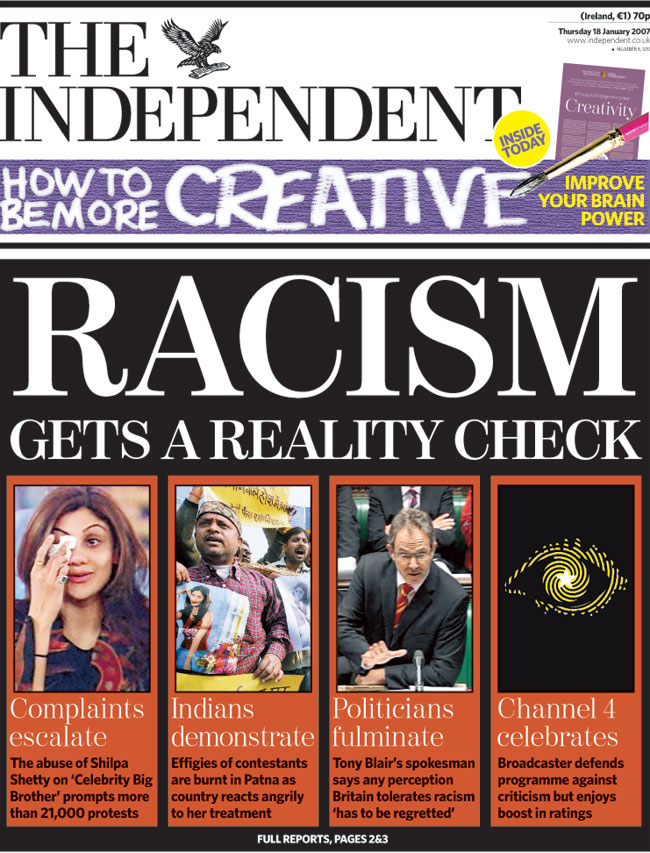
Shilpa Shetty


It's celebrity Big Brother time in the UK, and for those not following closely the massive international political event this particular series has become, check out the extended, front-page coverage in the Times of India. Seems Gordon Brown's visit to India has been refocused from business discussions to defending Britain's attitudes towards 'Others' writ large.

ITV | Independent

I watched the contestants enter the house, and I was excited that Shilpa Shetty, famous Bollywood actress, was in the BB house, as I imagined it would be intriguing to see the interactions between several UK celebrities who are celebrities because of their celebrity and a real-live millions-of-fans movie actress who was largely unknown to the others in the house. Not that there aren't others that have received fame and accolades because of their talent (musicians, actors, film directors) or beauty (beauty contestant winner) or writing (newspaper columnist). But the conflict on BB is between a former BB winner (and her family--famous because of Big Brother) in the house and Shilpa.

No one can pronounce her name. How hard is it? Is it harder than Imogen, the name of a Welsh woman in the earlier, regular Big Brother this past summer? Shill-pa. Two syllables, not difficult, all sounds used in the English language. Try pronouncing Worchester 'correctly' when you've grown up in America. So far some of the other members of the house have 'commented' on the food she eats, asked her if she lives in a shack back in India (um, not unless by 'shack' you mean 'full-floor luxury high-rise apartment in Mumbai', one of the most expensive cities on earth), refused to eat food cooked by her because 'you never know' where her hands have been (and Brits/westerners are so fastidious about washing our hands after we use the toilet).

So now I have to watch BB to see where this is going. Racism, certainly. Xenophobia, yes. Ignorance about the world, sure. Class-tension: absolutely. That's, I think, the crux of this. The group bullying her the most were characterised as 'chavs' by one tabloid I read yesterday on the train. This is about Shilpa, a wealthy Mumbaikar, not acting like the assumed lower-class category she is placed in in Britain by dint of her skin tone. And so those in the house who represent that lower class are threatened by this. Everyone is equal, sure. But everyone should be in their proper places as well. Shilpa isn't.

The racism/xenophobia angles are the ones getting the attention right now, and probably rightly so. But this is a bigger problem even than that large problem. It certainly reveals the harrassment that British-Asians must go through on a daily basis in Britain, and that revelation is, one hopes, a good thing for the country to see. But I do hope (in vain most likely) that this moves beyond labelling one family 'racist' and moving on. It's systemic, it's about more than just race (immigration, legacy of colonialism, asymmetries of economic globalisation, gender (oh yes), celebrity, class, wealth, and on and on).

I'm also interested in the overlapping and intersecting between the so-called diaspora South Asian community and the in-south-asia community. This is not the first incident or moment when the truth of the overlap between these seemingly different groups has been made obvious. But it is interesting. Shilpa isn't British Asian. She's Indian. Or is she? What's the difference? Is she, like many South Asians around the world and in South Asia, a transnational being? I think so--and I think she represents the norm more and more, particularly for those of a certain economic class in India. (less so in Pakistan and Bangladesh, but still evident there too)

So the story will unfold. And it's not trivial. It's big, it's politics, and it's very much reality.

Why I love my commute

Turns out much of south Wales is shut down, and they recorded 76mph winds about 200 yards from our house. Luckily, we sit down in a bit of a hollow and are very much protected from the wind. But even better is the commute: so far there are no reports of anyone being blown over on foot.

15 January 2007

Sick of me yet?

Frances links to what she very nicely describes as an example of real reporting. Frances praises the article as an effort 'to evaluate the truth of the administration's claims'. I couldn't agree more with the praise, but I think I might describe it a bit differently. And, I'd do so in a way that Paul would find amusing (note: Paul is the first of the TG comments, but his particular comment is quoted by the second TG comment - yes folks, they are different people, but they are a bit difficult to tell apart), by turning again to discourse.

To get to the point: it's a great article not only because it critically evaluates the claims the administration makes (rather than merely doing the ridiculous 'he said, she said' bullshit), but also because it steps back from the individual comments of members of the administration to see what kind of discourse they are trying to form, what kind of narrative they are very self-consciously seeking to construct. When reporters merely focus in on the specific fact (and then say it's affirmed on one side and denied on the other) they actually contribute to the administration's attempt to get the narrative out there - and they do so no matter the truth or falsity of the particular statement. It's the broader discourse that matters most.

Take WMD, for example. In the run-up to the Iraq war, each time a reporter would focus on WMD as the reason for going to war, they would actually reify the causal logic (i.e. must invade Iraq because they have WMD), even if they 'objectively' also reported on the 'opposing view' that there were no WMD. Put otherwise, all of this press about WMD (no matter its content) meant that the frame, the discourse, was always going to be WMD - and not 'a war for oil', not the 'neocon vision of the middle east', not 'the liberation of oppressed people's, not 'the march of democracy', not any other discourse.

But the article Frances links to steps back a bit from the particular claim about the importance of bombing the Samarra shrine. This lets it evaluate the truth of that claim, yes, but it also lets it show how the claim itself is a part of a broader discourse that the administration is trying to construct. In this discourse 2006 was a turning point (downward) but only because of a few anomalies, and we can correct those anomalies with a 'surge' (or whatever the hell we're supposed to call it).

My specific point: the more the Bushies can get this discourse out there, the less they'll have to deal with alternative discourses, e.g. those in which 2006 was not an anomaly but part and parcel of an utter failure of vision, coupled with complete incompetence of execution.

My general point: the Bush administration has consistently proved itself ingenius in using its ability to control the message it puts out (e.g. with press secretaries who never say anything, by flooding the Sunday talk shows, but insisting on 'talking points' up and down the party ranks and throughout much of the 'press') in order to help it consciously construct its discourses. Hence, the MSM has been a (silent or not) accomplice in this process, because they never step back and connect the dots. Hence, also, the genius of Jon Stewart, who does just this sort of dot-connecting on a regular basis (and also compares previous discourses with the current one 'greeted as liberators', 'can't imagine the occupation would cost more than the liberation', etc. in order to expose them) simply by showing lots of clips.

12 January 2007

He's Coming to America

I wonder if this is front page news over in the States, the way that it is here? I bet not.

David Beckham has signed a contract with the LA Galaxy (of MLS fame), making him the highest-paid footballer in the world, and the highest-paid sports figure in the US. I also wonder how the story will be covered elsewhere. Here, the framing for the piece is straightforward. For example:
the move signals the end of his career as a footballer of significance
This will be the repeated them: Beckham is done, his career is over - no chance to make it back onto the England squad, no chance to have any real impact. Of course, it's easy to tell the story this way, because it fits with the narrative already in place. Nothing is more popular in Britain than bashing on Beckham, both in terms of his celebrity status but also in terms of his presumed lack of ability on the pitch. I'm still very ignorant about football, but I actually thought Beckham was the most valuable player for England during the World Cup. I don't think he was England's best player, but his set-up abilities seemed to provide something to the team that no one eslse had - and he clearly had an impact on the games.

I can't help but be reminded of the stories when Wayne Gretzsky left the home of hockey in Canada to go to LA. The analogy has its limits since Gretzsky was still playing NHL hockey, and no football fan in Europe is going to consider the MLS a 'real league'. Still, Gretzsky surprised people (his hat trick in game 7 of the seminfinals, against Toronto ('93 I thnk), might have been his best single-game performance), and I wonder if Beckham might not do so as well.

10 January 2007

Puzzling

Greg links to another one of those tests that tries to place you on their version of the political map.

I find these questionairres puzzling because they rely so heavily upon completely charged, partial, and partisan statements. More importantly, these statements are taken from broader sets of political, ideological, and social discourses, and, so far as I can tell, the question is often trying hardest to see whether you recognise and are comfortable with that discourse. That is, they aren't actually asking you to reject or accept putative statements of fact or truth - even though this is the form the actual questions take. Instead, they are checking to see whether the statement resonates with you.

But the difference between these two modes of discourse (truth and resonance) creates some dilemmas. Thus, what to make of this question?

A significant advantage of a one-party state is that it avoids all the arguments that delay progress in a democratic political system.

You see, I count myself as something of a radical democrat; in almost every case, I'll favour democracy. But faced with answering whether the above statement is true or not, what do I do? Because,...well, yes, 'I agree' (I even strongly agree) that the above statement is true: a one party state does get things done. I'm not a big fan o the things it 'gets done', but it certainly gets them done.

If the question were: do you favour the liberty afforded by radical, particapatory democracy over the efficient decision-making of more authoritarian forms of government, then I can easily answer in a way that probably tells them what they want to know. But they don't want to ask questions like that.

Now, what does this tell us about the current state of society, politics, etc.? I haven't figured that one out yet. But the fact that they aren't really asking you direction questions but instead trying to tap into discourses in this way....I think that might be significant.

06 January 2007

Me and CNN, Again.

I see no way to justify my morbid fascination with cnn.com and its continually declining 'standards' for both reporting and the use of the English language. I can explain it as my one remaining effort to keep in touch with what's being presented as 'news' by the MSM in the US (these days I only read BBC, The Guardian, and FFB, of course).

This morning I noticed cnn.com's new 'feature'. It's called 'Story Highlights' and consists of 3 or 4 bullet points in a box at the top of each story. The idea seems to be that CNN's lengthy, in-depth, and highly sophisticated articles are just too much for the average reader to be able to handle, so we need the bullet points to help us out - or, more likely, to substitute for actually reading the article.

But here's the thing: the articles are ridiculously short to begin with! Check this one out, for example: the story of two planes almost colliding in Denver. The entire article is 182 words long. Even reading very verly slowly, it still takes well under a minute to read the whole article.

By the way, as a side note that's probably much more substantive than my above rant: both the Guardian and CNN's international edition have 'Bush reshuffles Generals in Iraq' as a headline this morning. But if you switch to the CNN US edition, you can't find such a headline; nor was there anything like that on the NY Times website. Weird? Definitely. Significant and meaningful? You tell me.

04 January 2007

OK, fine. We're using the silver!

The story of our nomadism continues, though I hope this somewhat traumatic chapter will be the final one (with no need for any sort of epilogue).

As you'll recall from chapter 6, almost immediately after storing almost all our worldy possessions inside a tin box in the desert of California, said 'storage unit' was broken into (we still think it might have been an inside job). Given that we were thousands of miles away in the valleys of central Pennsylvani, we had to assess the damage with only the aid of a blurry polaroid taken of the front of the unit. We surmised that the thieves had taken almost all the valuable items: all our tools; all our speakers, television and audio/video equipment; all our CDs; my golf clubs; and a few other big ticket items. We filed an insurance claim based on these presumptions and were very pleased when they wrote us a check (for a quite distinct outcome, see chapter 3 in which the movers destroy most of our stuff and fail to issue a fair reimbursement). And then, we tried to put the disturbance of the break-in behind us.

Zip forward more than 2 and 1/2 years to this Tuesday, when our remaining belongings from storage - after numerous items had been sold or given away, thanks to coordination by Steve and Kim on the ground in CA - arrived at our house. Our books, key pieces of furniture, our beloved rugs, all here safe and sound! However, only two of the expected 4 kitchen boxes showed up. And sure enough, we are missing: all our knives, given to us over the course of 5 years by my parents; all of our coffee mugs, a collection dating back to college; all of our good silverware, given to us by Rebecca's mom long ago; all of our good pots and pans, given to Rebecca by me the xmas before storing them; and a whole lot of other things that we can't even remember.

Ironically, while the thieves took things like our silverware and our mugs that are of worth only to us, they left us with the (almost) full set of 1936 Pennsylvania silver, including its gorgeous felt-lined mohagony box (also a lovely gift from Rebecca's mom). This, of course, would have been very pawn-able, and not something we were likely to need on a day-to-day basis.

But we're taking it as a sign, and we refuse to continue using the 'camping' utensils that we've suffered for the past 2 years. So to hell with it: we're using the silver! Any guests to our houehold can therefore expect fine dining utensils.

They can also expect 'parting gifts': we have almost a dozen very small US appliances (mostly desk lamps) that won't do us much good connected to 230v. So come visit us and take one home!

31 December 2006

it's a wonder I can think at all

for Christmas Sam got me a Nikon camera (love to take a pho-o-tograph) and as a result Paul and Art have been in my head for several days. that song is genius. it's about knowledge and seeing. it's about revolutions in perceptions of the world. and its datedness (Kodachrome) is now part of its import. remember when photos could be in colour? (I don't.) How about when HBO and MTV launched? What about your first Apple IIe? BASIC? Pong? electronically mailing friends across campus? it should be used as the kernel of all history/vision/perception lectures, except that none of today's current university students understand or appreciate the joys of the folk harmonising that Paul and Art pulled off. But I'd love to start a lecture with:

What is the connection here, between reading the writing on the wall--clearly a marker of adolescent toilet communication, the space where abstract insults and pick-up lines are traded--and Kodachrome? Is Simon happy about the shiny colours? The greens of summers? How does he communicate his cynicism? What does this tell us about the mood of mid-century popular consciousness? What is lost in the colour? How does nostalgia take shape here? And, why call upon his 'mama'? What kind of threat does she represent?

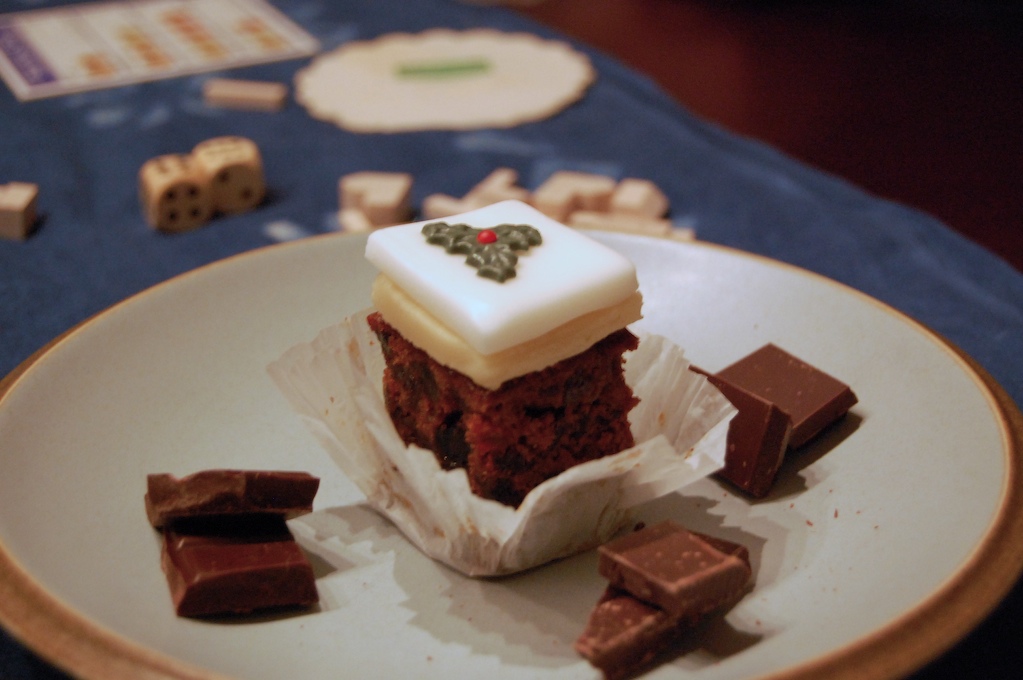
Ah. we can dream. meanwhile, my camera rocks. My portrait of an M&S mini christmas cake, below.

29 December 2006

Kate Fox, Watching the English

I just finished reading the above book, which I realise never made it into the blog list at the right but there you are. These things happen. It was recommended by several of our English friends as a good introduction to the behaviour and patterns of those raised in England.

Just to be clear once again, for those who haven't gotten it quite yet: we do not live in England. Wales. Different country, different language, different national history/heritage/pride. So the book was only of limited use for understanding our current surroundings, and indeed one of the interesting things was how much it did differ from our experiences in Wales.

I can highly recommend said text for any anglophile or frequent visitor to England who has observed various stereotypes (queueing, constantly saying 'sorry', self-deprecation) and wondered what was going on. Kate Fox is an anthropologist whose methods (like deliberately bumping into people for an afternoon and counting how many said 'sorry' to her) are as funny as many passages in the book (the English don't like revolutions, and so she articulates their 'protest' chant as: 'What do we want? GRADUAL CHANGE! When do we want it? IN DUE COURSE!' which I find hilarious. well, call-and-response just gets me).

She also details the minutiae of class distinctions, which are quite different from those in the US, needless to say. So it was fascinating. For example: folding your napkin neatly after a meal is considered 'common' as it implies that you might need/want to re-use it. to be properly upper class, you should crumple your napkin messily and leave it whereever. I find this intriguing.

We have also just experienced one of the other measures of class in both the US and the UK: the grocery store. Where you shop is as important as anything else for indicating class. Safeway--King Soopers--Albertsons was the order when we were growing up in suburban Denver, until the wave of organic/whole foods type places added a further upper category. In Minnesota you can go to Byerly's where the floors were carpeted and they hung chandeliers over the produce section. In PA and the NE it's Wegmans. (Blogged about this before here.) Other regions certainly have theirs, I'm sure.

Here in the UK it's Iceland--Lidl--Asda--Tesco--Sainsbury's--Waitrose--whole foods type places: Iceland carries only frozen stuff. hence the name. Asda is Walmart-owned. Say no more. Tesco, where we've been shopping, is more or less the middle class starting point. We just discovered, however, that Sainsbury's now delivers, and so we got our first Sainsbury's order this week. Very exciting. Over-designed packaging, new exotic dips, and generally you pay more for basically the same stuff. We do admit, however, that some of the items are, er, a bit better tasting than the Tesco equivalent. Does that make us elitists? Or are we merely justifying our striving for upper-class status by finding the food better at the one-tick-up store? Of course, if we were truly upper class we wouldn't care--crumpled napkin and all. we also probably wouldn't blog. Sigh. so much for striving.

24 December 2006

Mae hi'n niwlog!

indeed. with heathrow socked in by fog (due to lift today, hopefully) and Denver socked in by snow, we are somewhat proud of ourselves for the non-existent foresight that led to our decision to stay in our new house, nest, and relax this Christmas. because we are omniscient and can predict the weather. of course. what are the odds that LHR and DEN would be closed at the same time this year? well, the odds are one.

must make coffee and get in hot tub. happy Christmas eve!

21 December 2006

vielen dank

all my years of language study, slogging through college-level Sturm und Drang literature. all that work. not much fluency, sure. but a line on the ol' cv. and what am I using it for?
  • viewing Wagner's operatic oeuvre in the original, ohne subtitles?
  • reading Der Spiegel in the morning along with the other 8 international newspapers I read?
  • discussing the finer points of Goethe's aesthetics?
  • quibbling with Kaufmann's translation of Nietzsche?
No, no, no, and no. What am i doing with my german? Yep, you guessed it: buying shoes from on-line retailers! Filling up my Warenkorb in order to receive Stiefel and Schuhe in der Post. Ah. Deutsch. Ich liebe dich.

Gotta love the liberal arts. Brilliant. Wundervoll.

20 December 2006

home

we've been in the new house since September, and it just this past week clicked over into feeling a bit like home. No, we don't have our stuff yet (2nd Jan! very exciting!) and no, it won't wholly feel like home until we have things like matching, high quality silverware, more than one kitchen knife, pictures on the wall, our lovely rugs, and books, books, books.

But it is still starting to feel that way. and it's in a way that reminds me of the way Data of Star Trek TNG describes his understanding of love and friendship:
As I experience certain sensory input patterns my mental pathways become accustomed to them. The inputs eventually are anticipated and even missed when absent.
this is how it works with home. I know the silhouette of the back of the garden now. the feeling of the bannister, the way the door closes. it's not completely imbued with 'us-ness' yet, but the inputs are beginning to be anticipated. for sure.

PS. miss TNG. sigh.

11 December 2006

Hero worship, or not

I've been reading a one-degree-of-separation blog recently, Frankly Frivolous, which is about all the TV you're watching--the stuff you admit to and the stuff you don't. And, as someone with certain, and admittedly sometimes arbitrary, standards for dialogue/writing/directing that often mean shows get the axe in ep 3 ("Dude. Where are we?" killed Lost for us, sadly), it's nice to be able to keep up with things via someone else's intelligent commentary.

And so I must respond to the Heroes discussion in FF's recent blog post. Don't get me wrong. Heroes is one of our guilty pleasure, fluff TV watches. We find it intriguing--sort of 4400 without the buddy-cop element and without the full 'verse worked out completely. I tend to like the show, although we both could do without Nikki's story-line entirely, thank you very much. If one treats it like a soap and fast-forwards through the bits you're not keen on, it works well.

But I have a problem with it, which is the same problem that Alias (also guilty pleasure, also fab, also yummy on many levels) had: Or-ee-en-tal-ism. That's right. "Eenja" the place where wisdom is had. Place of monsoons, umbrellas, kids playing football (except they'd be playing cricket if it were going all-out stereotype), white columns and huge mansions, small dark dusty academic offices (that look oddly like the same place as the NY apartment inhabited by the same character), sultry women in saris, protective mothers, everyone is a scientist, everyone wears fab Banana Republic-style flowy clothing (from before BR sold out and became Extra-Special-Gap)...At least in Heroes they play to the "better stereotypes" if there is such a thing. In Alias "Eenja" was one big confusing bazaar with veiled women and people scraping in the dirt in their oh-so-colourful sparkly garb. And so it's just annoying. Right down to the accent that Sendhil Ramamurthy takes on. It grates a little. Mr. Miyagi for the 00s.

I think the portrayal of Japan has similar elements, but Hiro is a much better character than Mohinder, and he doesn't have to do the cheeseball spiritual abstract voiceover stuff--Japan is a place of ritualised office calasthenics, manga, and cubicles with Star-Trek obsessed inhabitants hip to American culture, Japanese style. so there's orientalism there too, just a different flavour and with a different edge. Others more familiar with Japan and its popular image can help me in analysing that.

Heroes' Orientalism is the boring kind. The overt, in-your-face, why-oh-why kind. Because of this, it doesn't make me stop watching the show. It's just too overt to be truly offensive. Perhaps it's a signal that South Asia has finally made it onto the radar screen of mainstream America: it's not just China and Japan anymore. Welcome to the club.

06 December 2006

Powers No. 2

I'm still planning that post about Hot Tubs. Indeed, I have to confess: I'm now planning a whole series of hot tub posts - certain to bore every reader and potential reader out there. But that process cannot begin until there is some literal closure. (And, yes, that is the correct use of literal.)

Thus, I thought I'd say a few words about the Richard Powers book that I recently finished reading. The book, Prisoner's Dilemma, is not Powers' most recent novel. That title goes to The Echo Maker, so kindly gifted to us by Rebecca's mom - and heroically delivered to us by Mike. I won't read that book for a while, not because I'm not eager to do so, but because I'm just enough of an ascetic to intentionally self-ration my consumption of sentences written by the man. My little history of reading Powers runs like this:

Galatea 2.2
Freely available in the sabbatical home fiction (and cookbook) library where we lived in State College, and then recommended to us by Joely. I read it, and liked it a lot - thought it an amazing combination of compelling plot, with genuine philosophical insight, and some nice techy stuff thrown in as a bonus. Some passages and sentences were mind-blowing, so I knew the guy had great talent. Still, I wouldn't call it one of the best books I ever read.

The Time of Our Singing
Imagine my surprise, then, when I bought the only Powers book available at the State College Barnes and Noble (or was it Borders, who can even tell the difference). The book looked long, and I was planning to fly from State College to London, so I figured it was good value for the money. I spent most of January, while Rebecca was away in India, reading it. It's the only book that, when I finished the last of almost 700 pages, I immediately and instinctively (without considering what I was doing) turned back to the beginning and reread the first chapter. It's also the only book I ever read over which I cried repeatedly. About a week or two after finishing it, I came to the inevitable conclusion that it was the best book I had ever read.

When Rebecca returned from India, I told her nothing about my perspective on the book; I simply handed it to her and said 'you must read this'. I said nothing to her while she read it, or when she was finished. About a week or so after her finishing, I asked what she thought of it. Her response: 'I think it's the best book I've ever read'.

Thus began our further journey through Powers Land, aided by finding most of his older novels used at Powell's later that summer.

The Gold Bug Variations
This is written on the same grand scale as the above book. It's massive, it's phenomenal, and it's an incredible feat. But it just doesn't quite pull it off. It's a fabulous book, but it misses the mark of genius. (Oh, and it finally made me understand - I think - something about DNA.)

Operation Wandering Soul
This is, by far I'd say, Powers' darkest novel, and it's not like he's normally all about light joyous gaiety. Everything artistic in ER was stolen from this book. It gives this incredible picture of the 80's - it's even funny in a way - and it has some of the best-written passages of any of his works. Still, it's a bit too depressing for my tastes. (And as you'll see below, I don't have a hypersensitivy to depressing works.)

Gain
This book centres on a protagonist dying of cancer and going through chemo; still, it's much lighter than the previous book. And it's totally gripping; and it's hopeful in its own way; and it 'gets' small-town America in the most amazing way. Brilliant book, probably tied for third on top Powers list.

Plowing the Dark
Virtual Reality, historical events, and a love story - what more could one want. A lot like Galatea, but deeper and richer and more intoxicating. Tied for third.

That brings me to the book I just finished, but I've about run out of steam. Prisoner's Dilemma is, above all, a story about family. It manages to tell that story while also talking, literally, about the Prisoner's Dilemma. It's also about hope and imagination, and even though this book too is about death, it's one of his most optimistic works. This text started off slowly for me, but it 'pulled it all together' - and this is the magic trick that Powers is always trying to pull off - so captivatingly and compellingly in the end, that it really took my breath away. It's his best short novel by far, I think, and his second best work overall.

I'd tell you to read it, of course, but it's rather obvious, isn't it, that I'm telling you to read them all.


03 December 2006

the root question...

I've posted before, of course, on beets. obviously. we had thanksgiving last week and thus fell behind in our studious consumption of the organic veg delivery. and then we got another bag-o-veg, including (and I do not exaggerate here) a 35 lb cantaloup squash pumpkin thing from the 19th century. because things were bigger then. (note how there's no scale on that picture from 1867?) How we got it home is a mystery to me. faced with more parsnips, carrots, swedes, pumpkin, leeks, and onion than we seem capable of eating I swing into proactive mode:
  • step one: adapt Indian potato curry recipe to swedes. eat for three days in a row. success.
  • step two: take all of the apples, core, stuff with butter, spices, and other yummy things, and make baked apples. success.
  • step three:given that we also overestimated our cheese consumption, we have several blocks of cheddar in the fridge. beets+parsnips+leeks+cheddar=yum. based on various 'au gratin' recipes on-line, I made the following. not at all weight watchers. not at all vegan. but, aside from the inevitable side dish of beef, vegetarian. (it's what's for dinner, remember?)
Rebecca's beet & parsnip au gratin
wash immense amounts of mud and earth off of root veg. seems that someone buried them in the earth prior to delivering them to me. odd.

wrap in foil and bake beets and parsnips for 2ish hours in a 180/350 degree oven until they are very much done

you can store them for later; at least let cool a bit

slice them into 1/4" round slices and layer them in alternating layers in a casserole dish (parsnips, beets. parsnips, beets. I made pretty pink and white pattern on the top. you can too.)

in a heavy saucepan sautee 2 leeks, sliced into rounds, including green bits. add a couple minced/mashed garlic cloves as well.

once the leeks are wilted and happy, add two tablespoons flour (or cornmeal--the only flour like thing I had around--worked well), stir around for a bit to coat the leeks. then add about 1/2 c water and mix--should be kind of like a runny-paste-o-leeks at this point. add in about 2ish c whole milk (I'm sure cream is better. didn't have any in the fridge)--let it get warm, then add about 2.5 c. grated cheese or more--I used white cheddars--a mix from the West country and Ireland. Nothing like diversity. Indeed. nothing like diversity.

add some pepper and dried thyme (2 teaspoons?), let the cheese melt into the sauce. don't let it boil. it's mostly milk.

pour cheese sauce over the beets and parsnips. grate some (or a lot of) cheese on top. bake, covered in foil, for 30 minutes or so at 180/350.

mm. cheese. beets. pretty pink and white and green. enjoy.

01 December 2006

Really?

In case you hadn't noticed (I hadn't), the online quiz phenomenon seems to have mutated a bit. I ran across this one about 'American accents' the other day, on a blog that was discussing how ridiculous Americans are for thinking they have 'no accent'. From previous posts, you know I both agree with this specific claim (about the ridiculousness) and also find the general discussion interesting.

However, I was not expecting these results:

What American accent do you have?
Your Result: Boston

You definitely have a Boston accent, even if you think you don't. Of course, that doesn't mean you are from the Boston area, you may also be from New Hampshire or Maine.

The West

The Midland

North Central

The Northeast

The Inland North

Philadelphia

The South

What American accent do you have?
Take More Quizzes

30 November 2006

partition was the right thing to do. discuss.

this was the debate topic I set for my colonialism & nationalism in India module this autumn. it was fun. we debated the merits of British India's partition into India and Pakistan in 1947, discussed the casualties (estimates range from less than 100,000 to over 500,000 dead, many more displaced/separated from their families, etc., and took sides on the issue.

at the end of the discussion I took 10 minutes to allow the students to express their own views (not their pro/con roles) on the topic. they all agreed that partition was not the right thing to do, that it had led to horrible migrations and deaths, it was the result of the calcification of a bi-polar discourse of Hindu and Muslim, and that it seemed like it could have been avoided, perhaps not in the years immediately prior to 1947, but had the discourse gone another way, it might not have seemed the only option.

so I asked/suggested: the situation in Iraq, then, given what you're saying about India/Pakistan, would also fall into the same category: partition would be a bad thing. most of them protested this, saying, in fact, that partition of Iraq would be a good thing and seem to solve the myriad problems there. Ah. history. we love learning from it, don't we!

yes, the situation is different in many ways, but it's also similar: artificially reified broad categories (Hindu/Muslim--Shia/Sunni/Kurd) mapped onto territory that itself relies on earlier colonial line-drawing. my expertise doesn't lie in Iraq, Kurdistan, or the Gulf region, but this piece provides a good argument against partition, and reveals the extent to which American pundits (next blog post! etymology of pundit and its political implications!) are making the same arguments that many in the British colonial establishment made. Let's hope that the Iraqis aren't forced, by the exigencies of international and domestic political maneuvering and typological pigeonholing, into positions similar to Jinnah and Nehru in 1946-7. Let's hope.

27 November 2006

weaver, weaving, wife: Greek? victorian? Manusamhita?

ah metaphors. ah etymologies. how I love thee. let me trace for you (really for me to get this clearer in my head) the path of my afternoon's research:

I'm preparing a talk on spinning for the department. this involves a wee bit of panic and some cursing of myself in June when December seemed so far away, the autumn so ripe with research time and possibilities. ha ha ha.

and so I am reading and thinking intensively. this is good. I sat down to read Chris Bayly's article on 'The origins of swadeshi' in Arjun Appadurai's book The Social Life of Things. Good information, interesting, and I hadn't quite developed my critique of the article as a whole when:
According to the Laws of Manu, unmarried girls were the spinners ('spinsters'), whereas after marriage they graduated to weavers (becoming 'wives'). (293)
intriguing. no citation. I google the Laws of Manu, now out of copyright after a few millennia. I search through it for 'wife' 'weaver' 'unmarried' 'girl' 'spinster' 'spin' and a few other terms. nothing. I google the relevant terms in google books and come up with, you guessed it, Bayly's essay.

so, to the etymology: where does wife come from? I go to my handy on-line sanskrit dictionary, look up wife. not really sounding like weaver nor related, meaning-wise, to weaver. hm. wife comes from the old English wif. this is sometimes connected to weaver, but only anecdotally (read: in blogposts I found when googling in hour 2 of this ordeal). then I hit on the motherlode: late nineteenth century texts waxing lyrical about the role of women! It seems that John Ruskin wrote this awesome dialogue-based text (Ethics of the Dust--note to self: must write book in dialogue form at some point, with myself as 'Lecturer') about women as weavers, claiming an Anglo-Saxon etymology for the connection, and advising girls that their good-wife status will be measured by their ability as seamstresses and weavers. and this then led me to (of course) the Greeks! Ruskin was obsessed with the weaving connections--good wife/bad wife--in Aeschylus and others, where the positive force of the weaver is contrasted to the arachnid-based nefarious web-spinner. In some discussions of this, I found the weaver-wife thing repeated.

it is unclear from this whether the weaver-wife connection was something that Ruskin/19th century classicists came up with that doesn't in fact relate to etymology at all or whether it really is in the greek (help here?). there's also the anglo-saxon 'peace-weaver' role for women, in which a woman would be wed across enemy lines in order to bridge a political disagreement. but in many of the sites I saw describing peace-weavers, they were distinct from 'wives' more broadly. some anglo-saxon history sites made the connection between weaver and wife, but with no citations I could find, and thus it would be just as likely their source was our dear Ruskin.

So: thoughts? wife-weaver? Greek connection? certainly none of my digging supported the Laws of Manu contention. I'm down the rabbit hole, and I've forgotten now why this is important. gender? India? spinsters? spinning? hm.

Thanksgiving in Wales (2)

a happy and turkey-filled Thanksgiving was had by all on this side of the atlantic--no access to pumpkin, and so instead we had butternut squash soup (care of Ruth from last year's soup discussion) and sweet potato-pecan pie (with crazed amounts of Southern Comfort and cream involved, making it oh-so-good). And thus Tday went without a hitch, save me forgetting completely about the lovely cranberry-apricot sauce I had made which is now adorning literally every meal we are eating. save breakfast. but I'm pondering it as a topping for oatmeal. anyone? thoughts?

Christmas tree is coming today and then decorating will have to ensue, despite the lack of our decs from California. this is what popcorn and cranberries are for, except when you have a dog. hm. we may resort to decorating with now useless RAM modules and Luke's old dog tags. shiny!

we also celebrated our colleague's recent book release this weekend, which is very exciting and will be coming out in paperback soon for those interested and yet not having the spare £55.

we've been watching thirtysomething. and this has caused me to reflect on adulthood, as when I first watched the show I was not thirtysomething. now I am firmly so, and it reads very differently. hosting thanksgiving is adult-like. but one still feels somehow as if one is playing house. does this go away? I used to think it would, but now I am not so sure. I think this: one never actually becomes the adult person you think your parents are when you are 8. For that adult person existed only in your 8-year-old mind. Really they were (early) thirtysomethings and making it up, just as you are now in your thirtysomething life. and thus adulthood. hm.

21 November 2006

securitise this...

now that I'm a politics person I'm learning you can talk about 'security' with regard to more than just military security or the security of the territorial boundaries of a state. one can speak of the feelings of security one has as a resident of said state, the security in knowing that your human rights aren't being violated (probably) and the like.

part of me likes the idea of moving political science beyond this strict state-centered/militaristic focus, sure. but it seems this has gone a bit far.

as with the US shifting the discourse around hunger to one of security.

conclusion? hunger no longer exists in the US. hurrah!
it's now low or very low food security. awesome.

click here for my favourite epidemiology blog's take on this.

20 November 2006

achieving real-people-dom

one of our on-going sagas here in the UK is to attempt to get credit. due to the credit-based culture in the US, back there we could have purchased several fairly expensive cars on the amount of credit Lady Visa and Master Card were willing to give us (shout out to Renaissance Faire geeks there). Here, we have been turned down flat for credit cards by our bank and mortgage lender, Lloyds, and generously offered a card with a £260 limit by the dolts over at Barclays (they are dolts not because of this, this just adds to their ridiculousness).

So I'm in M&S (Marks and Spencer, like KFC has decided that initials are the way to go for the whole re-branding/updating. and it's working marvelously) in city centre purchasing sheets for Mike's recent visit. I'm asked if I have an M&S card, I prepare the automatic, pavlovian response of: no, no thanks, no really no and then stifle it: why not apply? they don't keep track of the applications here in the UK (in the US they do) and so it doesn't matter if I get rejected. I apply, and lo! after many weeks in the empty ocean of credit-less-ness, we have arrived at the shores of mastercard, a full £2000 limit to our names! yea, praise be to the goddesses of credit. may the beeping of cash registers and the tapping of numberpads forever hail thy glory.

the card arrives: they market it as 'the little black number' it's matte black. with chartreuse edges. it is, in a word, awesome. we are now real people.

I heart capitalism.

13 November 2006

pumpkin redux

so a pumpkin is a fruit. that blows my mind. I discovered this upon trying to find out if the object that was included in my organic veg delivery was more a canteloupe melon or a squash. I thought the latter until I actually cut into the thing, which was melon-like in consistency but green on the outside, much like this picture from the 19th century. I have decided to treat it like a squash. I will report back on what happens. In the meantime, I am feeling very late Victorian.

stand well clear...

remember the voice in the Mac 1984 commercial? not the voiceover at the end, but the voice of the overlord? that sort of British-as-all-knowing-elite complex of referents they were going for? imagine that voice saying:

Stand Well Clear. Vehicle Reversing. Stand Well Clear. Vehicle Reversing. Stand Well Clear. Vehicle Reversing.

This is what I'm experiencing right now, coupled with a beeping sound also reminiscent of the tones in the 1984 ad.

only this is coming from the large cocacola truck backing its red, round logo-covered rear end directly towards my window (my office is directly above the loading dock for the cafe below).

surreal to say the least. the Orwellian future is in fact, as we all know, a late-capitalist info-regime, where we 'participate' in our own bodily destruction with dollars and pence.

Stand well clear.

12 November 2006

Calling All Would-Be Book Cover Design Experts

I have a very long post on the techne, phronesis, and really the ontos of hot tubs. I don't know if anyone really wants to read it, but I will be compelled to write it. However, I can't put that together until or if the tub stops leaking like a sieve.

So, for now, something that may interest more readers. I just found out that the publisher of the book I hope to be submitting this spring actually wants me to pick out the cover image. On the one hand, it sounds fantastic to have some control over such an important process; on the other, I haven't a clue what to pick and the 'power' scares me. On my first book I had zero input on design/cover/layout issues.

The book is an attempt to illuminate queer theory through readings of US television shows, and to use queer theory to offer a set of readings of TV shows and to produce a set of arguments about the politics of television. The book is titled 'The Queer Politics of Television' and it will have six chapters on various shows (Six Feet Under, Desperate Housewives, The L Word, Big Love, and one other). With that in mind, I ask all of you:

What image should go on the cover?

10 November 2006

hot tub photos


the saga in pictures. more coming today. we have power, we have water, and now all we need is for the electric heater to heat that water. 12 degrees (Celsius) and rising!

Click here.

Many thanks to Julian & Jane for trekking out from London for Tues & Wed crucial early stages, and to Mike for trekking from the wilds of Denver and spending his week off making his fingers bleed. Fun was had by all.

08 November 2006

where have I been?

well, I'm still here--just overwhelmed with the stuff. And rather than spending the downtime blogging, I find it difficult to be in front of the computer for more than is completely necessary. that said, I should add: hurrah for our discussion on the whole marriage thing. I didn't participate for many things I would have said were said already, and more elegantly than I was capable of.

In other news: Bangladeshi Mohammed Yunus and the Grameen Bank got the Nobel Peace prize a week or so back--go microfinance. may it someday alleviate poverty everywhere, put power in the hands of the meek, and change the world. Luke: happier on the beach than in the park, because in the park he has a job to do--namely, eliminate the squirrel population. Dogs laugh on the beach. Hot tub: growing in our back yard. Pictures soon. Rumsfeld: buh bye. we should send him a nice fruitbasket.

Currently reading: Umberto Eco's Foucault's Pendulum. The daVinci code on crack. or acid. or something.

Welsh: week 5 or so. Shumai! Bora da! Noswaith dda! Mae hi'n niwlog. [hello! good morning! good evening! It's foggy.] very exciting.